AI in Emergency Medicine
AI Fall-Risk Alerts in the ED: The Referral Is the Weak Link
Why this matters
A machine-learning model predicts which older ED patients will return after a fall. In the live rollout, only 15% of referred patients scheduled a falls clinic visit. What the evidence shows and what to build before go-live.
Recommended next step
Pair this article with the free guide or course store if you want a more structured framework you can apply at the bedside or in leadership conversations.
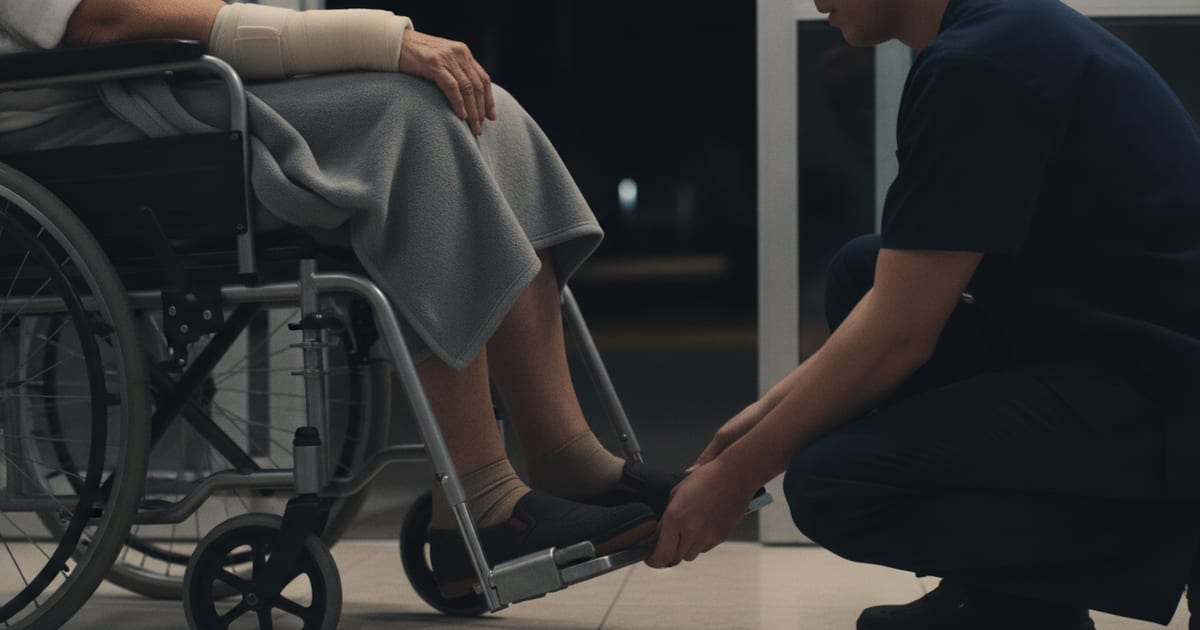
At 2 a.m., an 83-year-old widow who lives alone is ready to go home with a splint on her wrist. She tripped on her back step. When the resident enters the discharge disposition, the record opens an alert: high risk of returning to the emergency department for a fall in the next six months, with a suggested referral to the mobility and falls clinic. The resident signs the referral and picks up the next chart. Nobody asks how she will get across town to a clinic appointment.
The model behind an alert like this predicts reasonably well. Where these programs fail is the step after the click, and the emergency department has to own that step if the alert is going to prevent a fall.
What the Wisconsin fall-risk model predicts
The best-described example comes from the University of Wisconsin. Patterson and colleagues studied 9,687 visits by adults aged 65 and older who were discharged from one academic Level I trauma center ED and had a primary care provider in the same health system [1]. They trained models on the earliest 75% of visits and tested them on the latest 25%. The outcome was a return visit to that ED for a fall within six months. It happened after 8.8% of visits. The models drew on 725 features already in the record, including vital signs, labs, prior visits and chief complaint. The best random forest model reached an area under the curve of 0.78 (95% CI 0.74 to 0.81) on those held-out visits [1].
That is better than bedside tools have managed in other studies. In an external validation in 779 older adults admitted through a Brazilian ED for reasons other than a fall, the four-item Carpenter instrument predicted falls in the next 180 days with an area under the curve of 0.62 [2]. In a retrospective Australian model-development cohort of community-dwelling patients aged 75 and older who presented after a fall, the Clinical Frailty Scale had a C-statistic of 0.534 for a fall-related return within six months [3]. The populations and outcomes differ, so the numbers do not compare directly.
A model trained on coded return visits learns only the falls the coding captured. When the same Wisconsin group ran a language-processing tool over ED notes from 50,153 visits by older adults, 7,086 of the 14,604 fall-related visits it found (49%) carried no external-cause fall code [4]. Patients found only in the notes were more likely to have a serious underlying illness, such as sepsis or acute kidney disease, than a traumatic injury [4]. Ask how a vendor defined its outcome before you trust its accuracy figure.
From a risk score to a number needed to treat
The Wisconsin team then translated accuracy into operations. Their falls clinic could take about 10 ED referrals a week. At the threshold that produced 10 referrals a week, the projected number needed to treat was 12.4 referrals to prevent one return visit for a fall [1]. If only 5 slots were available, a ridge regression model with a slightly lower area under the curve was the better choice, at a number needed to treat of about 10 [1].
The projections assume that every referred patient attends and that the clinic delivers a 38% relative reduction in fallers, a figure they derived from the PROFET trial [1]. PROFET randomized 397 community-dwelling adults aged 65 and older who came to an accident and emergency department after a fall. The intervention group received a detailed medical and occupational therapy assessment with referral to services as indicated. Over 12 months, that group reported 183 falls against 510 in the usual-care group, with an odds ratio for falling of 0.39 (95% CI 0.23 to 0.66) [5].
The pooled evidence is weaker than PROFET alone. A meta-analysis of 19 trials of multifactorial assessment and intervention in primary care, community and emergency settings pooled 18 of them for the number of fallers and found a risk ratio of 0.91 (95% CI 0.82 to 1.02) [6]. Its subgroup analysis suggested that programs which deliver treatment do better than programs that offer only advice and a referral [6].
Where the program leaks
The alert fires for discharged patients with an in-system primary care provider when the clinician documents a discharge disposition [7]. By April 2023, two EDs had flagged 1,326 encounters. Clinicians placed a referral for roughly 30% of them, which reached 339 unique patients. Only 45 of those 339 (15%) had scheduled a clinic appointment [7]. The clinic estimates that about 80% of patients referred from other sources attend [7]. These are early figures, and the team reported some improvement after changing its messaging and patient follow-up [7]. Now rerun the projection. If only 15% of referred patients even schedule and the clinic works as well as assumed, 12.4 divided by 0.15 is about 83 referrals per fall-related return prevented. The authors did not publish that calculation; it is ours. It is also a floor, because a scheduled visit is not an attended one.
Two interview studies explain the losses. Brief interviews with 16 resident physicians and advanced practice providers who had seen the alert found five groups of factors: the design of the alert, misunderstanding of the tool or the referral process, the pace of the department, the clinician's own impression of the patient's fall risk, and a referral process the clinician could not see into [8]. Interviews with 15 older adults in the ED found that patients trusted their ED clinician to use the tool, and named ordinary barriers to follow-up, such as transportation and clinic distance [9].
The fall outcome itself is still pending. The protocol's primary outcome is a completed referral, meaning a first visit at the falls clinic. Six-month return visits for falls are the secondary outcome, analyzed with a regression discontinuity design, with data collection running into 2026 and Medicare claims added to catch visits to outside EDs [7]. A PubMed search in late November 2026 found no published outcome paper.
What to build before you switch one on
Size the threshold to the capacity of the service it feeds. Choose the cutoff with the clinic, in referrals per week, the way the Wisconsin group did [1].
Give the referral an owner after the patient leaves. A scheduler or navigator call, a ride, and a named contact person address the barriers patients actually reported [9]. Moving part of the assessment into the ED visit is a second option. In the GAPcare II randomized trial at three EDs in Rhode Island and Colorado, 93% of 96 intervention patients received a bedside pharmacist consultation and 83% a physical therapy consultation, and ED length of stay did not differ between arms (4.6 versus 4.4 hours) [12]. That report covers process measures only; it does not report falls. A Geriatric Emergency Department Guidelines 2.0 systematic review found that therapist fall evaluations during the ED visit were associated with fewer ED revisits at 1, 2 and 6 months, without more admissions or a longer stay. Co-interventions and heterogeneity across the 6 datasets limit how hard that can be pushed [10]. The 2022 World Falls Guidelines recommend opportunistic case finding and a full multifactorial assessment for those at high risk, which is the step the alert is meant to start [11].
Teach clinicians what happens after the click; the Wisconsin team used its 10-minute interviews to correct misreadings of the referral process [8]. Our pieces on who owns an AI alert and running a tool silently first apply.
Measure the chain monthly: flagged, referred, scheduled, attended, and returned for a fall, including visits elsewhere. A dashboard that stops at referrals placed reports success while patients stay home.
Key Takeaways
- The Wisconsin model predicted a six-month return ED visit for a fall with an area under the curve of 0.78. Separate studies in different populations, with different outcomes, reported 0.62 for the Carpenter instrument and 0.534 for the Clinical Frailty Scale.
- Set the alert threshold by clinic capacity. At 10 referrals a week, the projected number needed to treat was 12.4, and that projection assumed every referred patient attended.
- In the live rollout, 15% of referred patients had scheduled a clinic visit. Separately, the clinic estimates that about 80% of patients referred from other sources attend.
- Track flagged, referred, scheduled, attended and returned-for-fall counts together. Referral counts alone measure clicks.
FAQ
Can machine learning predict falls after an emergency department visit?
Yes, moderately well. A Wisconsin model built from routine record data predicted a return ED visit for a fall within six months with an area under the curve of 0.78 [1]. It was trained at a single academic ED on patients with in-system primary care, so it needs local validation before use elsewhere.
Does referring older ED patients to a falls clinic prevent falls?
The best-known ED-based trial, PROFET, found an odds ratio for falling of 0.39 when patients received a medical and occupational therapy assessment with targeted referral [5]. A later meta-analysis of multifactorial trials, pooling 18 trials for this outcome, found a smaller effect on the number of fallers, with a confidence interval that included no effect, and suggested that programs which provide treatment do better than referral alone [6].
Why do older adults not complete falls clinic referrals from the ED?
In the Wisconsin rollout, only 15% of referred patients scheduled an appointment [7]. Patients named transportation and clinic distance as barriers [9]. Clinicians cited a referral process they could not see into, the pace of the department and their own view of the patient's risk [8].
Dr. Chet's Take
I have practiced emergency medicine for more than 25 years and now work at a Level I academic trauma center. This work gets the hard part right. The Wisconsin team did not stop at an accuracy figure. They asked how many patients the clinic could see, what each referral would buy, and how many referred patients would actually schedule. That last question is easy to skip, and the rollout's answer was humbling. The core argument holds. The model is good enough to start with. The department loses the patients in the days after they leave, and a falls clinic cannot help a patient it never sees. An alert that fires at the moment of discharge asks the busiest person in the building to start a process that runs on daytime schedulers, phone calls and rides.
That being said, I think the design question is bigger than the follow-up rate. The model was trained and run only on patients with a primary care provider inside the same health system. That was a sensible research choice, and it keeps the referral loop closed. It also means the older adult with no doctor, no family nearby and no reliable phone sits outside the tool entirely, and I would expect that patient to be the one who falls through. The honest answer is that nobody knows yet whether the alert prevents a single fall, and I would not sell it to a board as fall prevention until the outcome data arrive. As a TelEmergency medical director, I would want any version of this tool built for rural hospitals to plan a follow-up path that does not depend on a clinic two counties away. Video visits and home-based physical therapy deserve a look before the alert is switched on.
If you are leading an emergency department and someone offers you a fall-risk alert, ask who makes the phone call on Monday morning, and put a name and a job title on that task before go-live. Ask who arranges the ride, because a referral without transport is a letter the patient cannot answer. Make sure your night-shift attendings know what the alert means and what happens after they click it, so the conversation at the bedside matches the call the patient gets later. Then report the chain every month, from flag to attended visit, in the same meeting where you review returns. If the attended number stays small, change the follow-up process before you touch the model. A fall-risk program is judged by the patients who reach the clinic, not by the alerts the computer fires.
— Chester Shermer, MD, FACEP | Emergency Medicine, 25+ Years Clinical Experience | State Surgeon
Continue Your Training
If you're an emergency physician (or any clinician treating patients daily) trying to understand how AI will actually impact your clinical practice — not just the hype — I put together a free practical guide. You can download the AI in EM Survival Guide here.
Browse All Courses at Global MedOps Command
Relevant Reading on Global MedOps Command:
How to Avoid Becoming an AI Casualty — Dr. Shermer's guide to navigating AI tools in clinical and operational settings without compromising judgment or patient outcomes.
Emergency Department Efficiency Playbook — Practical systems for throughput, triage optimization, and operational efficiency.
Read more from Dr. Shermer on Medium
Connect with Dr. Shermer: LinkedIn — Chester "Chet" Shermer, MD, FACEP.
References
- Patterson BW, Engstrom CJ, Sah V, et al. Training and interpreting machine learning algorithms to evaluate fall risk after emergency department visits. Med Care. 2019;57(7):560-566. PubMed 31157707
- Curiati PK, Arruda MDS, Carpenter CR, et al. Predicting posthospitalization falls in Brazilian older adults: external validation of the Carpenter instrument. Acad Emerg Med. 2024;31(7):688-695. PubMed 38450932
- Barton L, Nelson M, Strudwick K, et al. The Clinical Frailty Scale offers little utility as part of a prediction model for community-dwelling older fallers at risk of re-presenting to the emergency department. Australas Emerg Care. 2025;28(2):110-115. PubMed 39627046
- Hekman DJ, Maru AP, Barton HJ, et al. Evaluation of falls detected by natural language processing algorithm and not coded external cause of morbidity. JAMIA Open. 2025;8(3):ooaf047. PubMed 40584739
- Close J, Ellis M, Hooper R, et al. Prevention of falls in the elderly trial (PROFET): a randomised controlled trial. Lancet. 1999;353(9147):93-97. PubMed 10023893
- Gates S, Fisher JD, Cooke MW, et al. Multifactorial assessment and targeted intervention for preventing falls and injuries among older people in community and emergency care settings: systematic review and meta-analysis. BMJ. 2008;336(7636):130-133. PubMed 18089892
- Hekman DJ, Cochran AL, Maru AP, et al. Effectiveness of an emergency department-based machine learning clinical decision support tool to prevent outpatient falls among older adults: protocol for a quasi-experimental study. JMIR Res Protoc. 2023;12:e48128. PubMed 37535416
- Barton HJ, Maru A, Leaf MA, et al. Academic detailing as a health information technology implementation method: supporting the design and implementation of an emergency department-based clinical decision support tool to prevent future falls. JMIR Hum Factors. 2024;11:e52592. PubMed 38635318
- Barton HJ, Maru A, Lin O, et al. Considerations for developing patient-centered clinical decision support: preventing older adult falls after emergency department visits. Proc Hum Factors Ergon Soc Annu Meet. 2024;68(1):553-556. PubMed 40600005
- Southerland LT, Curiati PK, Shih RD, et al. Physical and occupational therapist evaluations for fall prevention in the emergency department: a Geriatric ED Guidelines 2.0 systematic review. Acad Emerg Med. 2026;33(3):e70201. PubMed 41354970
- Montero-Odasso M, van der Velde N, Martin FC, et al. World guidelines for falls prevention and management for older adults: a global initiative. Age Ageing. 2022;51(9):afac205. PubMed 36178003
- Goldberg EM, Keene S, Bounds M, et al. Emergency department visit outcomes of a multicenter randomized trial of a fall prevention intervention. Acad Emerg Med. 2026;33(1):e70228. PubMed 41603307
Related simulation training: EM-Sim · EMS-MedSim · Books by Dr. Shermer
Keep reading
Related reading and your next step.
Ready to go further? Move from this article into structured training, scenario-based rehearsal, and more physician-written guidance.
Course
Translate the article into a repeatable framework
Use the physician-led course when you want a structured framework for evaluating AI tools, protecting clinical judgment, and leading implementation decisions.
Simulation
Practice the decision path under pressure
Use EM-Sim when you want scenario-based repetition that turns article-level insight into physician-facing emergency-medicine reps.
Blog
Browse more articles
Explore the full blog for more on AI in emergency medicine, then head to the course and simulation pages when you want the structured next step.
Related Articles
AI in Emergency Medicine
AI Admission Scores in the ED: Where the 12 Minutes Came From
An AI admission score cut ED length of stay by 12 minutes at Mayo Clinic without more 72-hour returns. The gain came from earlier hospitalist conversations, and two other trials show why accuracy alone does not change care.
AI in Emergency Medicine
AI Pneumothorax Flags on Chest X-Ray: What a Clean Read Means
An AI overlay finds no pneumothorax on a supine trauma film. What the commercial tools detect on supine and upright films, why chest tubes fooled early algorithms, and when to look again with ultrasound or CT.
AI in Emergency Medicine
Can AI Size a Burn? What the First ED Study Found
A multimodal AI model matched emergency physicians on burn size but missed 13 of 16 deep burns. Why depth, not size, decides the transfer call.