AI in Emergency Medicine
Mastering Night Shifts: Emergency Medicine Survival Guide
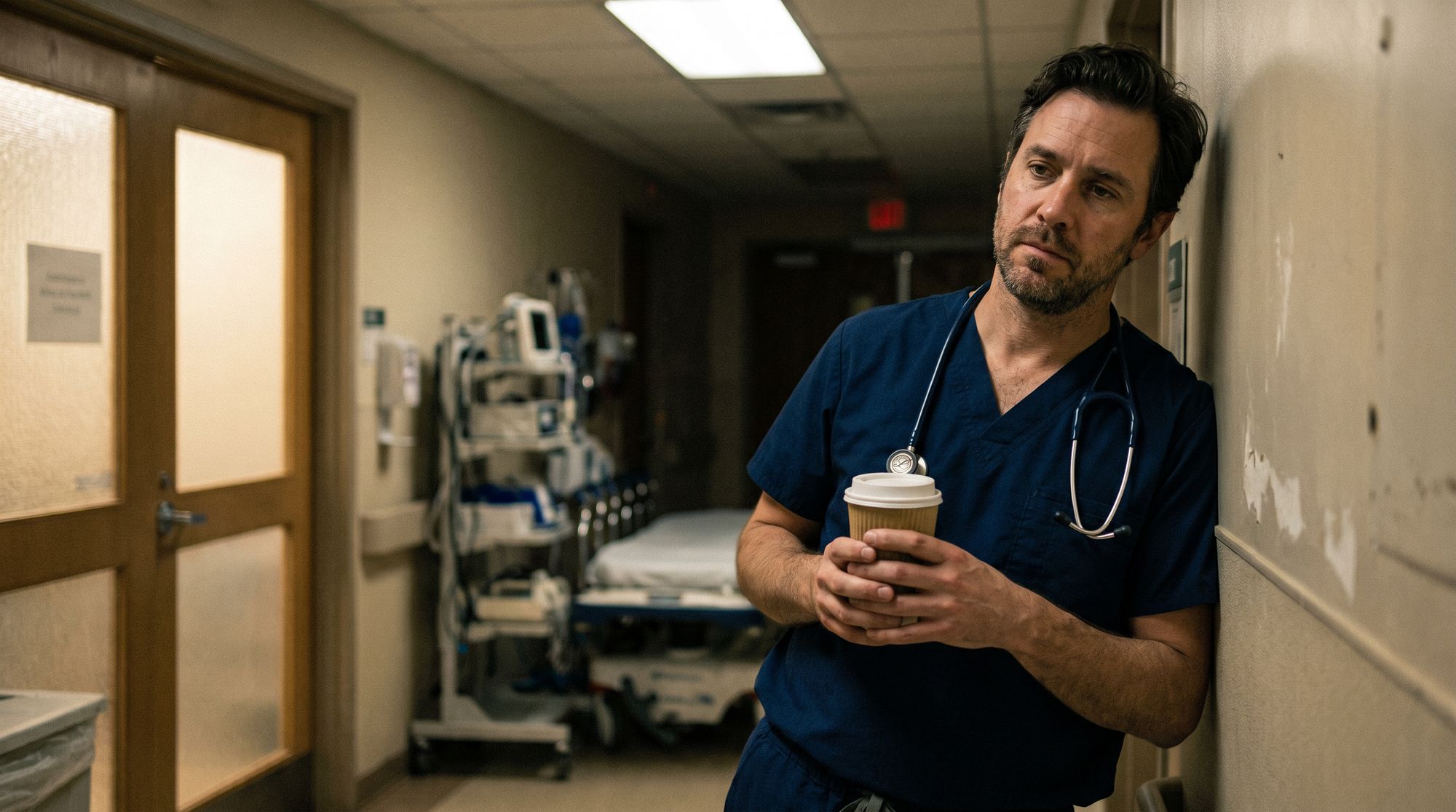
Why this matters
Struggling with night shifts? Learn how to optimize your sleep schedule, manage the circadian trough, and thrive in emergency medicine as a nocturnist.
Recommended next step
Pair this article with the free guide or course store if you want a more structured framework you can apply at the bedside or in leadership conversations.
The Physiological Reality of the 3:00 AM Trough
At 3:00 AM, a nurse hands you a chart. Chest pain, altered mental status, and a sepsis workup pending — all at once. Your training is intact. Your instincts are solid. But your brain is running on borrowed time.
Circadian misalignment doesn't just make you tired — it selectively degrades the executive function you rely on most.
This is what researchers call "forced desynchrony." As Dr. Steven Lockley of Harvard Medical School describes it, the transition from day to night shift creates a neurological state that directly undermines the complex triage decisions emergency medicine demands. Reaction times slow. Working memory compresses. The brain's capacity to hold multiple patient scenarios simultaneously — a core clinical skill — drops measurably during the circadian trough between roughly 2:00 and 5:00 AM.
The American College of Emergency Physicians puts a number to it: night shift workers in emergency medicine face a 20–30% increased risk of clinical errors due to circadian misalignment alone.
That's not a character flaw. That's biology.
Framing the night shift as an individual endurance test misses the point entirely. It's a systemic challenge — one that requires structural solutions, not just stronger coffee. That's where the real conversation begins, and it starts with whether the economics of dedicated nocturnist roles actually support better clinical outcomes.
The Economics of the Nocturnist: Is the Differential Worth It?
Dedicated nocturnist roles offer real financial upside — but the calculus goes well beyond the pay stub.
According to the National Library of Medicine, nocturnist programs frequently offer financial incentives and increased scheduling flexibility to compensate for circadian disruption. That differential typically ranges from 15% to 25% above standard daytime rates, depending on the group and market. For a physician early in their career managing student loan debt, that's a meaningful number.
That being said, the financial case isn't purely additive. Here's an honest look at what the nocturnist life actually trades:
Pro: Higher base compensation — night differentials and fewer administrative obligations often translate to greater hourly value.
Pro: Clinical autonomy — reduced attending oversight and leaner overnight teams can sharpen independent decision-making.
Pro: Department retention — dedicated nocturnist programs reduce burnout-driven turnover across the entire group, not just the night team.
Con: Social isolation — missing evenings, weekends, and family rhythms compounds over months and years.
Con: Hidden patient safety costs — rotating schedules without the best sleep schedule for night shift workers carry real risk. The Annals of Emergency Medicine data shows a 35% higher near-miss rate on nights compared to days.
The ROI calculation is only accurate when you factor in those near-miss costs. A department that rotates physicians without a structured recovery framework isn't saving money — it's deferring liability. The financial differential earns its value when it's paired with intentional circadian management, which brings us directly to the sleep architecture decisions that make or break a nocturnist career.
Strategic Sleep: Beyond the Standard 'Dark Room' Advice
Knowing how to adjust to night shift work is the difference between surviving a block and actually performing at your peak when patients need it most.
The standard advice — blackout curtains, white noise, melatonin — is a floor, not a ceiling. The real leverage is in structure.
Anchor sleep vs. split sleep comes down to your schedule's consistency. Stanford Medicine's research on circadian stability supports maintaining a consistent "anchor" sleep period — even a 4-hour block at the same time daily — to prevent your circadian rhythm from fragmenting entirely. Split sleep, where you break rest into two shorter windows, works better during a run of consecutive nights when full consolidation isn't realistic.
Prophylactic napping is non-negotiable before a night block. A 90-minute nap in the late afternoon — roughly 5:00 PM to 6:30 PM — before your first shift loads your prefrontal cortex before the 3:00 AM trough hits.
Timed caffeine and light discipline sharpen that edge further. Caffeine at shift start and again around 1:00 AM. Blue-light blocking glasses on your drive home to prevent cortisol suppression of your recovery sleep.
The drive home is a clinical decision. Treat post-shift fatigue like a 0.08 BAC — because the research supports that comparison. Pull over. Call someone. Use a rideshare. Arriving safely matters more than arriving fast.
These protocols don't require perfect conditions. They require intention — which is also exactly what the next layer of protection, simulation training, is designed to reinforce.
Simulation as a Safety Net for the Fatigued Brain
When the circadian trough hits — that brutal window between 3:00 AM and 5:00 AM — your prefrontal cortex isn't running the show anymore. Procedural memory is.
Simulation-based training works precisely because it hardwires complex protocols below the level of conscious executive function, which is exactly what you need when fatigue has already taxed that system. Research published in the Journal of Emergency Nursing confirms that simulation-based training improves clinical performance and decision-making during this physiological low point — not by keeping you sharp, but by making the right moves automatic.
In practice, this means drilling RSI sequences, pediatric code algorithms, and trauma activations under conditions that replicate physiological stress — elevated heart rate, time pressure, sensory overload. That's the training environment where procedural gaps surface. A smooth RSI on a Tuesday afternoon tells you almost nothing about your performance at 4:15 AM after a six-hour stretch of high-acuity patients.
EM-Sim and MilMedSim frameworks take this further, designing scenarios that specifically probe overnight workflow failure points — handoff breakdowns, delayed lab recognition, and misread rhythm strips that a rested provider would catch immediately.
That kind of deliberate exposure changes your relationship with fatigue. You're no longer hoping you perform well under pressure. You've already proven it.
The question becomes: what tools can further support that performance when human cognition has its limits? That's where the conversation around AI in night shift emergency medicine is getting genuinely interesting.
AI and Decision Support: The Future of Overnight Triage
AI-driven decision support is most valuable precisely when emergency physician shift work is at its most dangerous — during the circadian trough, when cognitive load peaks and clinical errors cluster.
AI doesn't replace clinical judgment; it protects it. When your prefrontal cortex is running on fumes at 4:00 AM, an AI-driven workflow can flag the subtle ST-segment elevation you're about to miss or surface a radiographic finding that's easy to dismiss on a fatigued read. According to the Global MedOps Command Strategy Framework, these tools act as a safety net for routine triage tasks, reducing the cognitive burden so your attention stays where it belongs — on the complex, undifferentiated patient in bay three.
That being said, the tool is only as safe as the strategy behind it. Physician-led AI integration isn't optional. Deploying AI without a clear governance structure creates a different risk: over-reliance, liability gaps, and the erosion of the clinical instincts you've built over years of overnight shifts. Before you integrate any decision-support tool into your department's workflow, understand where liability lands when the algorithm and the outcome diverge.
"AI in the emergency department should function as a co-pilot, not an autopilot. The physician's hand must remain on the controls, especially when the stakes are highest."
Getting this balance right at the systems level — scheduling, simulation, and AI strategy working in concert — is where sustained overnight performance is built.
The Bottom Line: Surviving and Thriving on the Night Shift
Mastering the night shift demands four concrete disciplines — sleep architecture, scheduling advocacy, simulation, and AI literacy — and the physicians who commit to all four outlast those who don't.
Anchor sleep first. Protect a consistent daytime sleep block using blackout curtains, white noise, and strict light hygiene after your shift. Circadian biology doesn't negotiate.
Push for nocturnist-led scheduling. Rotating shift models fragment recovery and amplify error risk. A dedicated nocturnist model — with an appropriate nocturnist salary differential to reflect the physiological burden — stabilizes both the clinician and the department. Advocate for it loudly.
Harden protocols through simulation. A systematic approach to shift work can reduce near-miss incidents by targeting the root causes of cognitive fatigue, according to research published in the Annals of Emergency Medicine. Simulation builds the procedural memory that holds when your prefrontal cortex is offline at 4:00 AM.
Invest in AI literacy now. Decision support tools are only as useful as the clinician operating them. Build that literacy before you need it — not during a high-acuity surge at 3:30 AM.
That being said, none of these tools function in isolation. They form a system — and building that system is a leadership decision, not a personal one. The next step belongs to the people running emergency medicine operations.
Operational Readiness: A Call to Action for EM Leaders
The clinicians who survive the night shift are trained for it — the departments that thrive have built systems around that training.
That distinction matters. Individual discipline carries you through the circadian trough in emergency medicine, but organizational strategy is what protects your patients and your staff at scale. Clinical ops managers, this is your directive: pull your night shift error rates, compare them against day shift benchmarks, and treat the gap as a patient safety problem — because it is.
AI education is no longer optional. Physician-led training provides a practical framework for evaluating and adopting AI in emergency care while protecting clinical judgment — and it belongs in every EM residency curriculum and department onboarding protocol today, not in the next accreditation cycle.
That being said, education without application is incomplete. Global MedOps Command's simulation platforms are built specifically for the environments where errors are most costly — overnight, under-resourced, and high-stakes. If you're ready to move from reading about the problem to solving it, see what our learners say about training that translates directly to the floor.
The mission is simple: Prepared for Every Emergency. The night shift isn't an exception to that standard. It's the test of it.
For More Information
If you’re an emergency physician (or any clinician treating patients daily) trying to understand how AI will actually impact your clinical practice — not just the hype — I put together a free practical guide. You can download it here: AI in EM Survival Guide
Chester “Chet” Shermer, MD, FACEP is a Professor of Emergency Medicine, TeleHealth, HEMS and Critical Care Transport, and State Surgeon for the Army National Guard. He is the founder of Global MedOps Command and creator of the course AI in Emergency Medicine: Becoming AI Bulletproof. His books — Emergency Department Efficiency Playbook, How to Avoid Becoming an AI Casualty, The Emergency Medicine Observation Unit , Night Shift Strong, and Confident Under Fire: Overcoming Imposter Syndrome in Emergency Medicine— are available on Gumroad, Amazon, and Kajabi. Connect: globalmedopscommand.com | LinkedIn Read more on the GMOC blog.
Key Takeaways
Pro: Higher base compensation — night differentials and fewer administrative obligations often translate to greater hourly value.
Pro: Clinical autonomy — reduced attending oversight and leaner overnight teams can sharpen independent decision-making.
Pro: Department retention — dedicated nocturnist programs reduce burnout-driven turnover across the entire group, not just the night team.
Con: Social isolation — missing evenings, weekends, and family rhythms compounds over months and years.
Anchor sleep first. Protect a consistent daytime sleep block using blackout curtains, white noise, and strict light hygiene after your shift. Circadian biology doesn't negotiate.
Keep reading
Related reading and your next step.
Ready to go further? Move from this article into structured training, scenario-based rehearsal, and more physician-written guidance.
Course
Translate the article into a repeatable framework
Use the physician-led course when you want a structured framework for evaluating AI tools, protecting clinical judgment, and leading implementation decisions.
Simulation
Practice the decision path under pressure
Use EM-Sim when you want scenario-based repetition that turns article-level insight into physician-facing emergency-medicine reps.
Blog
Browse more articles
Explore the full blog for more on AI in emergency medicine, then head to the course and simulation pages when you want the structured next step.
Related Articles
AI in Emergency Medicine
AI Fracture Detection in the ED: What the Evidence Supports
AI fracture tools make clinicians more sensitive in reader studies, and NICE allows four of them under conditions. No randomized trial has yet published patient outcomes. How to deploy one as a second reader.
ED Management
Left Without Being Seen: What Emergency Physicians Can Actually Fix
Patients who leave without being seen come back more often, and the front end that drives most walkouts is the part an emergency physician can redesign. Here is what the evidence supports.
AI in Emergency Medicine
AI for ED Staffing: Forecasts Are Not Shift Plans
AI can forecast emergency department arrivals, but a patient count is not a staffing plan. Learn how to validate forecasts, keep human control, and test a safer workflow.