Simulation & Training
EMS Simulation Training: Reps Before the Real Call
Why this matters
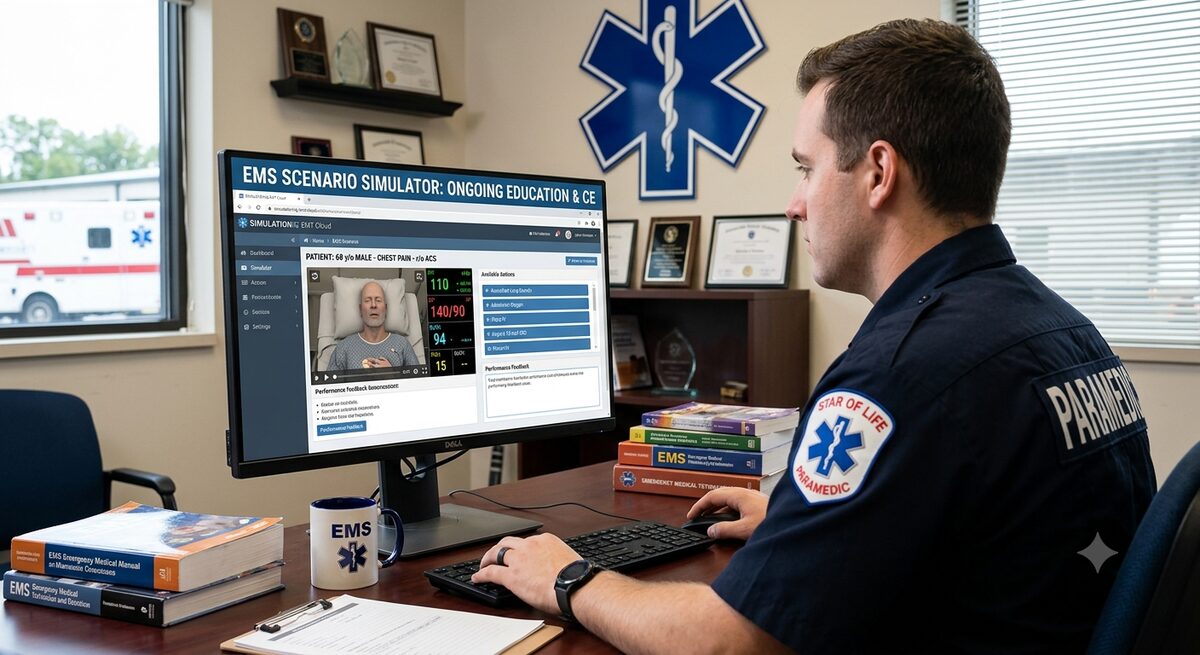
The skills most likely to kill a patient when fumbled are the ones we practice least. A HEMS medical director's evidence-based framework for EMS simulation training that actually transfers to the street.
Recommended next step
Pair this article with the free guide or course store if you want a more structured framework you can apply at the bedside or in leadership conversations.
The worst place to perform your first surgical airway is the back of a helicopter at 2 a.m., in turbulence, on a hypoxic patient with a bloody airway. Yet that is exactly where many prehospital clinicians get their first real rep, because the skills most likely to kill a patient when fumbled are the ones we practice least. As a HEMS medical director and State Surgeon for the Army National Guard, I have spent years watching the gap between what our people are credentialed to do and what they have actually rehearsed. EMS simulation training is how you close that gap — but only if you do it right, and most programs do not. In this post I will cover what the evidence says simulation actually buys you, the scenario design framework I use for street and battlefield medicine, and why fidelity lives somewhere most programs never look.
What High-Fidelity Simulation Actually Buys You
Let me anchor this in the evidence before I give you my opinions. A systematic review in the International Journal of Paramedicine examining simulation-based training among practicing paramedics and EMTs found its strongest effects on objective measures: task performance, procedural success rates, and the ability to identify errors. Participants also reported perceived gains in knowledge and skill, which matter more in prehospital medicine than academics tend to credit. A paramedic who has run a pediatric arrest eight times in the sim lab does not freeze at minute one of the real thing.
Two honest caveats from the same literature. First, the review's documented benefits center on objective performance and skill measures rather than a head-to-head win over didactic teaching — and the broader simulation literature is consistent that these gains depend on structured debriefing and deliberate practice, not the simulation alone. Second, the research still has not convincingly tied simulation to downstream patient outcomes like mortality or length of stay — no study in the review documented such outcomes. I am not going to oversell what the data shows. What it shows is performance: faster correct decisions, higher procedural success, fewer unforced errors. In my world, that is the whole game.
Here is what that looks like operationally. My flight crews carry maybe a handful of true low-frequency, high-acuity skills: surgical cricothyrotomy, finger thoracostomy, peri-mortem decisions, crashing pediatric patients. A busy flight medic might go two years without touching one of them in the field. Skill decay does not care about your certification card — the psychomotor and decision components both degrade measurably within months, not years. Simulation is not an enrichment activity for those skills. It is the only mechanism that keeps them alive between real patients, and any training officer who treats it as an annual checkbox is running a credentialing program, not a readiness program.
There is also a retention argument that agencies keep missing. EMS is bleeding experienced people, and one of the quieter drivers is clinicians who feel unprepared for the calls that scare them. A medic who dreads the pediatric arrest she has never rehearsed is a medic closer to leaving the profession. Training programs that build demonstrable competence in the high-stakes calls do double duty: better patient care and a workforce that stays. If you are fighting a retention problem with pay bumps alone, you are ignoring half the equation.
A Scenario Design Framework That Transfers to the Street
A scenario is not a skills station with a backstory. If your simulation is "here is a mannequin, it needs an IO," you are rehearsing a motor task, not a call. Every scenario I write for our platforms follows the same six-element structure, because the structure is what forces decision-making under uncertainty.
Dispatch information comes first, and it should be incomplete or partially wrong — because it always is. "58-year-old male, chest pain" that turns out to be a dissection. Scene size-up follows: hazards, access problems, resource gaps. Make the crew ask for what they cannot see.
Patient presentation is scripted in phases, not as a static vital-signs card. The patient at minute zero is not the patient at minute eight, and the scenario should evolve whether or not the crew intervenes — faster if they intervene wrong.
Decision points are the heart of the scenario, and I write them in explicitly: the moment where the crew must choose between transport now versus stabilize first, between a supraglottic airway and a surgical one, between load-and-go and working the arrest on scene. A scenario without a forced decision under time pressure is a demonstration, not a simulation.
Expected interventions give your evaluators an objective checklist — what a competent crew should do, in what sequence, within what window. And debriefing points are written before the scenario ever runs: the three teaching targets this case exists to hit. If you are building the debrief in the hallway afterward, you built the scenario backward.
Run them spaced, not massed. Four short scenarios quarterly beat one marathon sim day annually, every time — massed practice produces performance on the day and forgetting by the next month, while spaced repetition is what actually moves skills into long-term retention. And rotate roles deliberately: the medic who always leads should run a scenario as the second crew member, because half of prehospital failure modes live in the handoffs and the followership, not the interventions. This six-element format is exactly how every scenario in my simulation libraries is built — more on those below.
The Pearl: Fidelity Lives in the Decisions, Not the Mannequin
Now the part that will save your training budget. After years of running simulation across HEMS, ground EMS, and military medicine, here is the most expensive misunderstanding in the field: programs buy fidelity in silicone when fidelity actually lives in the decision architecture.
I have watched agencies spend north of eighty thousand dollars on a mannequin that blinks and sweats, then run scenarios on it with no time pressure, no incomplete information, no consequences for a wrong branch — and produce medics who perform beautifully in the classroom and hesitate in the field. I have also run scenarios with a twenty-dollar airway trainer duct-taped into a wrecked car at night, with a screaming bystander and a radio that would not reach medical control, that changed how a crew ran calls for years. The military figured this out before civilian EMS did. Tactical Combat Casualty Care training does not chase mannequin realism; it chases conditions: darkness, noise, weight, fatigue, ambiguity about whether the scene is safe. In my National Guard role I have watched medics run tourniquet and airway drills in full kit, in the dark, after a ruck — on trainers that cost less than a stethoscope — and come out more field-ready than colleagues trained on top-shelf mannequins in a quiet, well-lit lab. The variable that transferred was the stress, not the silicone. The evidence is consistent with this — the review found the impact of simulation lived in objective performance gains, and the mannequin's fidelity was not what the outcomes hinged on. The mannequin was never the active ingredient. The decisions were.
So audit your program with one question: at how many points in this scenario must the learner make a consequential choice with incomplete information under time pressure? If the answer is zero, it does not matter what the mannequin cost — you are running theater. And one more pearl from the debriefing side: the scenario is only the stimulus. The learning happens in the twenty minutes afterward, when a skilled debriefer walks the crew back through each decision point and asks what they saw, what they weighed, and what they would do differently. Cut the scenario short before you ever cut the debrief.
The debrief itself has a discipline. Use a structure — advocacy-inquiry, plus-delta, whatever your team will actually sustain — but the non-negotiables are the same: the crew talks more than the facilitator, the conversation stays on decisions rather than personalities, and every debrief ends with one specific behavioral commitment for the next real call. "Communicate better" is not a commitment. "I will verbalize my airway backup plan before the first attempt" is.
Stress inoculation plus decision reps plus disciplined debriefing. That is the formula. Everything else is production value.
The Bottom Line
The evidence says simulation drives the outcomes that matter in the field — performance, procedural success, error recognition — and that the effect comes from deliberate practice and structured debriefing, not from the price tag of the equipment.
Three takeaways. First, treat low-frequency, high-acuity skills as perishable: spaced simulation reps are the only thing keeping them alive between real patients. Second, build every scenario on the six-element structure — dispatch, size-up, phased presentation, forced decision points, expected interventions, pre-written debriefing targets. Third, buy decisions, not silicone: fidelity is the pressure and ambiguity in the scenario, and the debrief is where the learning actually happens.
If you want scenarios already built this way, my simulation libraries are live: emsmedsim.globalmedopscommand.com for EMS crews, emsim.globalmedopscommand.com for emergency physicians, and milmedsim.globalmedopscommand.com for military medics — each scenario written in the full six-element format with debriefing points included.
If you're an emergency physician (or any clinician treating patients daily) trying to understand how AI will actually impact your clinical practice—not just the hype—I put together a free practical guide. You can download it here.
Sources
- Bienstock J, Heuer A, Zhang Y. "Simulation-Based Training and Its Use Amongst Practicing Paramedics and Emergency Medical Technicians: An Evidence-Based Systematic Review." International Journal of Paramedicine. doi:10.56068/VWHV8080. https://internationaljournalofparamedicine.com/index.php/ijop/article/view/2334
- Miller DR. "Simulation Training as a Strategy for Workforce Retention in EMS." JEMS, 2025. https://www.jems.com/ems-management/simulation-training-as-a-strategy-for-workforce-retention-in-ems/
Keep reading
Related reading and your next step.
Ready to go further? Move from this article into structured training, scenario-based rehearsal, and more physician-written guidance.
Course
Translate the article into a repeatable framework
Use the physician-led course when you want a structured framework for evaluating AI tools, protecting clinical judgment, and leading implementation decisions.
Simulation
Rehearse the EMS workflow in scenario form
Move from reading into field-facing scenarios with EMS-MedSim when you want crews, educators, or agencies to practice triage, handoff, and operational decisions under pressure.
Blog
Browse more articles
Explore the full blog for more on AI in emergency medicine, then head to the course and simulation pages when you want the structured next step.
Related Articles
AI in Emergency Medicine
AI Fracture Detection in the ED: What the Evidence Supports
AI fracture tools make clinicians more sensitive in reader studies, and NICE allows four of them under conditions. No randomized trial has yet published patient outcomes. How to deploy one as a second reader.
ED Management
Left Without Being Seen: What Emergency Physicians Can Actually Fix
Patients who leave without being seen come back more often, and the front end that drives most walkouts is the part an emergency physician can redesign. Here is what the evidence supports.
AI in Emergency Medicine
AI for ED Staffing: Forecasts Are Not Shift Plans
AI can forecast emergency department arrivals, but a patient count is not a staffing plan. Learn how to validate forecasts, keep human control, and test a safer workflow.