Clinical AI
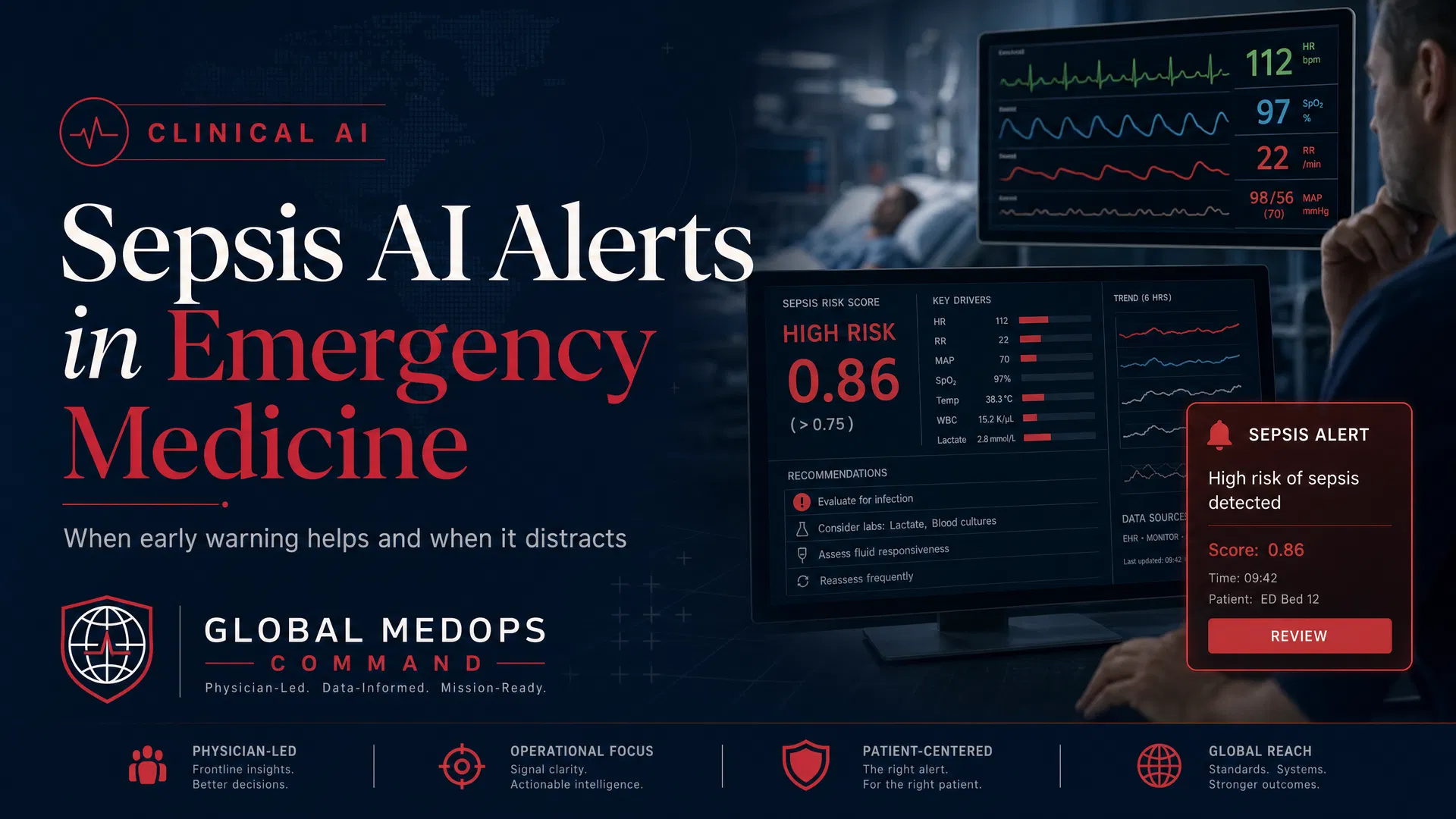
Sepsis AI Alerts in Emergency Medicine: When Early Warning Helps and When It Distracts
Why this matters
A practical physician perspective on sepsis AI alerts in emergency medicine, including where early-warning support helps, where alerting fails, and how to validate signal quality.
Recommended next step
Pair this article with the free guide or course store if you want a more structured framework you can apply at the bedside or in leadership conversations.
Sepsis is one of the most common places where health systems hope AI can make a real difference. The clinical logic is compelling. If a model can identify a deteriorating patient earlier than usual workflow does, clinicians may be able to accelerate reassessment, laboratory review, antibiotics, source control planning, and disposition decisions before delay becomes consequential.
That possibility matters in emergency medicine because the early part of a sepsis case is often messy. Patients present with incomplete stories, overlapping diagnoses, and evolving physiology. The same reality that makes early detection valuable also makes it hard. Sepsis AI deserves attention, but it should be evaluated with the same discipline as any other high-stakes support tool.
Where sepsis AI can be genuinely helpful
The strongest case for sepsis AI is as an early-warning support layer rather than a replacement for bedside judgment. A model may notice combinations of vitals, labs, past history, and trajectory that deserve earlier review. In crowded emergency settings, that can help clinicians spot deterioration or reprioritize attention before a patient obviously declares themselves.
The value is especially clear when the system supports action rather than noise. If an alert leads to an earlier reassessment, a more careful look at perfusion, a clearer differential, or faster escalation to a sicker patient, it may be doing useful work. The key is that it should sharpen clinician focus, not fragment it.
Where sepsis alerting often goes wrong
The most obvious failure is false positives. Emergency departments already operate in environments full of competing alarms, reminders, and workflow interruptions. A sepsis model that fires too often may train clinicians to click past it rather than investigate it. At that point, the organization has not built intelligence. It has added another source of attention debt.
A second failure is diagnostic flattening. Sepsis is a syndrome, not a neat checkbox. Many patients in the ED have abnormal vital signs or inflammatory markers for reasons that are not sepsis. If the system nudges clinicians toward premature closure, it can distort the broader differential instead of improving it.
A third failure is poor integration with operational reality. An alert is only useful if the team knows what it should trigger. Should it prompt reassessment, immediate labs, an attending notification, a nursing workflow change, or a chart review? An alert without a response pathway is mostly an interruption.
What to validate before adoption
Departments should ask which outcome the model is trying to predict and whether that outcome maps cleanly onto emergency workflow. Is the tool predicting sepsis itself, ICU need, clinical deterioration, or mortality risk? Those are related but not interchangeable. A model can perform acceptably on one target and still be operationally misaligned with the bedside decision it is supposed to support.
It is also worth reviewing performance across patient groups where sepsis recognition is often difficult: older adults, immunocompromised patients, subtle presentations, and patients whose complaint looks noninfectious early in the encounter. If validation only focuses on average performance, the tool may disappoint in the exact cases where clinicians hoped it would help most.
Another crucial question is how many alerts were actually actionable. Emergency physicians should care less about how impressive a model looks in a deck and more about whether the alert changed care for the better without overwhelming staff with false urgency.
A smarter implementation sequence
Start with silent-mode review before frontline exposure. Compare model output with clinical course, examine the misses, and look carefully at the false positives. Then move into a limited pilot where alerts are advisory and case review is mandatory. That lets leaders see not only whether the model is mathematically interesting, but whether it behaves like a useful emergency department tool.
Implementation should also define ownership. Who reviews patterns of misfire? Who decides whether thresholds change? Who has authority to pause the system? Sepsis AI should not sit in a governance gray zone where everyone assumes someone else is monitoring it.
The bottom line for emergency physicians
Sepsis AI can be helpful when it sharpens reassessment and supports earlier recognition in genuinely ambiguous situations. It becomes harmful when it adds noise, narrows thinking too early, or gives teams an excuse to outsource suspicion.
Emergency physicians should treat sepsis AI as a support layer that earns trust through local validation, usable workflow, and transparent review. If you want a broader physician-led framework for reviewing AI tools in emergency care, begin with the free guide, explore the AI course, or browse the books and resources for deeper operational reading.
Keep reading
Related reading and your next step.
Ready to go further? Move from this article into structured training, scenario-based rehearsal, and more physician-written guidance.
Course
Translate the article into a repeatable framework
Use the physician-led course when you want a structured framework for evaluating AI tools, protecting clinical judgment, and leading implementation decisions.
Simulation
Practice the decision path under pressure
Use EM-Sim when you want scenario-based repetition that turns article-level insight into physician-facing emergency-medicine reps.
Blog
Browse more articles
Explore the full blog for more on AI in emergency medicine, then head to the course and simulation pages when you want the structured next step.
Related Articles
AI in Emergency Medicine
AI Fracture Detection in the ED: What the Evidence Supports
AI fracture tools make clinicians more sensitive in reader studies, and NICE allows four of them under conditions. No randomized trial has yet published patient outcomes. How to deploy one as a second reader.
ED Management
Left Without Being Seen: What Emergency Physicians Can Actually Fix
Patients who leave without being seen come back more often, and the front end that drives most walkouts is the part an emergency physician can redesign. Here is what the evidence supports.
AI in Emergency Medicine
AI for ED Staffing: Forecasts Are Not Shift Plans
AI can forecast emergency department arrivals, but a patient count is not a staffing plan. Learn how to validate forecasts, keep human control, and test a safer workflow.