Medicolegal
Emergency Physician AI Liability: How to Review, Document, and Escalate Safely
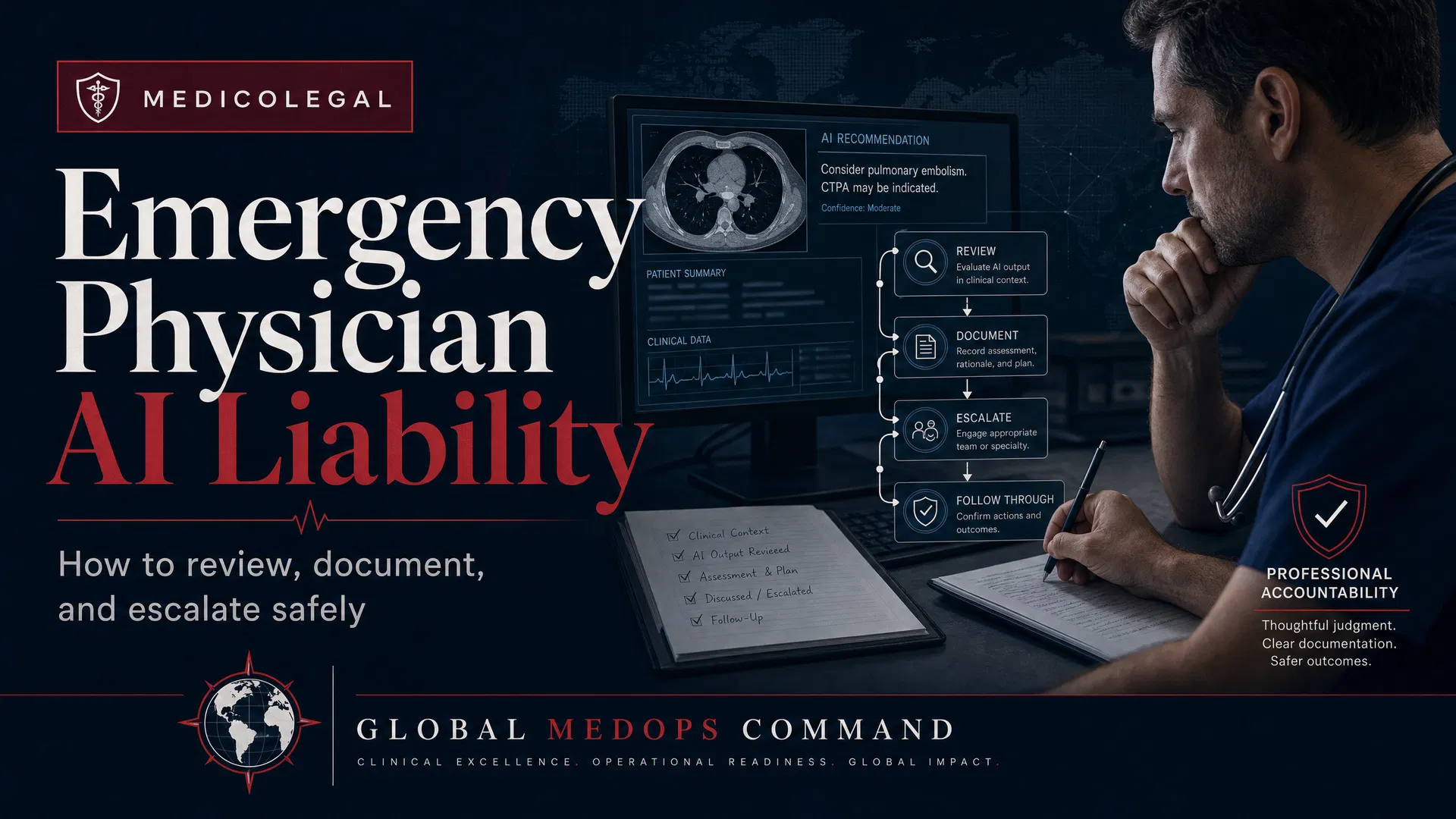
Why this matters
A practical emergency medicine guide to AI liability, including physician oversight, documentation expectations, escalation rules, and safer review habits when using AI tools.
Recommended next step
Pair this article with the free guide or course store if you want a more structured framework you can apply at the bedside or in leadership conversations.
As more AI tools enter emergency medicine, many physicians are asking the same question in different forms: if I use this tool and something goes wrong, where does responsibility actually land? That question matters because emergency clinicians are being asked to evaluate documentation assistants, decision-support tools, triage systems, and draft communication tools long before medicolegal norms feel settled.
The safest starting point is simple. If a physician uses AI in patient care, the physician should assume that professional responsibility for review and clinical judgment still remains with the clinician. That does not mean every AI tool is inherently dangerous. It means the presence of software does not remove the human obligation to verify, contextualize, and decide.
Liability questions usually begin with workflow, not the courtroom
Physicians often imagine AI liability as a future legal argument, but most risk starts much earlier in the workflow. A note is signed without close review. An AI suggestion is accepted because it sounds plausible. A discharge explanation is not checked for accuracy. An alert is ignored because the system has produced too much noise. By the time a case becomes a formal dispute, the operational failure already happened at the point of use.
That is why the practical medicolegal conversation should focus on habits. What exactly is the clinician expected to review? What parts of the workflow can never be delegated? What kind of escalation is required when the tool output conflicts with bedside judgment? Those questions are more useful than abstract debates about whether AI is “liable.”
Review standards matter more than slogans
Emergency physicians should define explicit review expectations for any tool they use. If the tool drafts documentation, the physician should verify the history, exam, reassessment, and medical decision-making language. If the tool summarizes records, the clinician should check that the summary did not omit contradictory information. If the tool suggests a risk level or possible diagnosis, the physician should understand what inputs drove that suggestion and whether local workflow makes those inputs reliable.
A useful rule is that the more consequential the output, the more direct the review should be. High-acuity, high-uncertainty, and high-risk decisions deserve the most skepticism. Emergency medicine is full of cases where the dangerous problem is not the obvious one, and AI systems can sound more confident than the information available actually justifies.
Documentation habits that reduce downstream risk
Documentation should still reflect clinician reasoning, not just AI-assisted prose. The chart should make it clear what mattered, what was uncertain, what changed during the visit, and why the final disposition made sense. If a note becomes smoother but less specific about judgment, it may be more readable while becoming less protective.
It is also wise to document escalation and review behavior where relevant. If an AI-generated draft was corrected in a meaningful way, if a concerning alert prompted reassessment, or if a decision was made against the implied direction of a tool because bedside findings argued otherwise, that kind of reasoning matters. The point is not to narrate the software constantly. The point is to leave a chart that shows human clinical judgment remained active and visible.
When to escalate rather than proceed
Physicians should have a low threshold to escalate concerns when a tool behaves unpredictably, conflicts with repeated bedside findings, or starts generating output that looks persuasive but unreliable. Escalation can mean pausing use, asking for peer review, notifying leadership, or pushing for a governance review of the tool itself.
The dangerous scenario is not merely a bad output. The dangerous scenario is a workflow where no one feels ownership over repeated bad output. Once that happens, clinicians are left carrying risk for a system that has lost operational trust.
A safer mindset for emergency clinicians
The right posture is neither blind trust nor blanket rejection. It is structured skepticism. Emergency physicians should use AI where it clearly supports workflow, improves clarity, or helps recover time, but only when review expectations remain unmistakable and escalation paths are real.
That mindset protects both patients and clinicians because it keeps the physician in the loop in a meaningful way rather than a ceremonial one. Oversight is not just “looking at the screen before clicking sign.” It is understanding where the tool helps, where it drifts, and when the bedside picture should overrule the software without hesitation.
The bottom line
AI liability in emergency medicine will keep evolving, but the safest current approach is operationally clear: review carefully, document reasoning visibly, escalate tool concerns early, and never let polished output substitute for judgment.
For a broader physician-led framework on safe AI adoption, review the AI Bulletproof course, explore the books and resources, or reach out through the contact page if your group needs a workshop, lecture, or implementation discussion.
Keep reading
Related reading and your next step.
Ready to go further? Move from this article into structured training, scenario-based rehearsal, and more physician-written guidance.
Course
Translate the article into a repeatable framework
Use the physician-led course when you want a structured framework for evaluating AI tools, protecting clinical judgment, and leading implementation decisions.
Simulation
Practice the decision path under pressure
Use EM-Sim when you want scenario-based repetition that turns article-level insight into physician-facing emergency-medicine reps.
Blog
Browse more articles
Explore the full blog for more on AI in emergency medicine, then head to the course and simulation pages when you want the structured next step.
Related Articles
AI in Emergency Medicine
AI Fracture Detection in the ED: What the Evidence Supports
AI fracture tools make clinicians more sensitive in reader studies, and NICE allows four of them under conditions. No randomized trial has yet published patient outcomes. How to deploy one as a second reader.
ED Management
Left Without Being Seen: What Emergency Physicians Can Actually Fix
Patients who leave without being seen come back more often, and the front end that drives most walkouts is the part an emergency physician can redesign. Here is what the evidence supports.
AI in Emergency Medicine
AI for ED Staffing: Forecasts Are Not Shift Plans
AI can forecast emergency department arrivals, but a patient count is not a staffing plan. Learn how to validate forecasts, keep human control, and test a safer workflow.