AI in Emergency Medicine
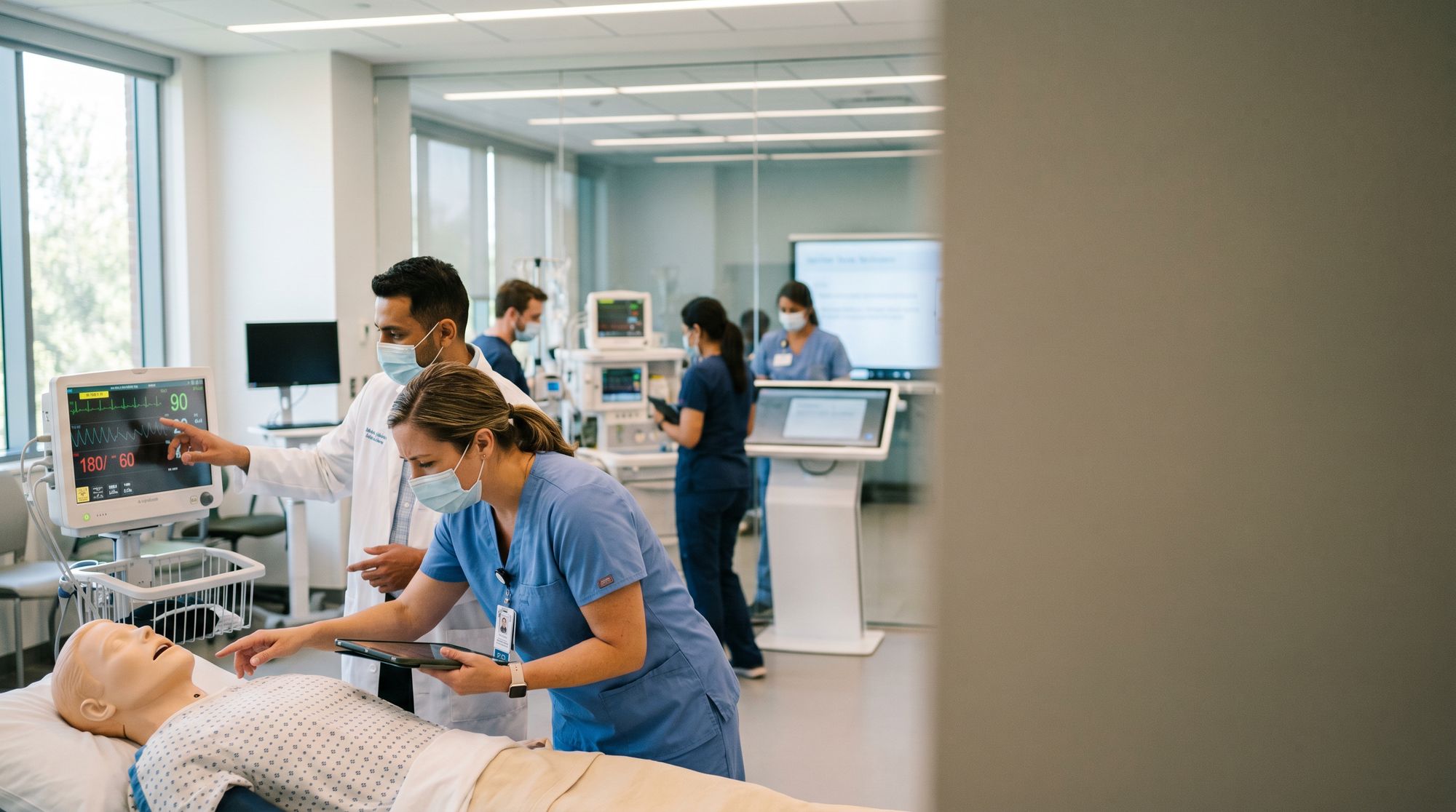
AI Emergency Medicine Simulation: The New Gold Standard
Why this matters
Discover how AI-driven simulation is transforming emergency medicine training. Move beyond static manikins with immersive, scenario-driven medical…
Recommended next step
Pair this article with the free guide or course store if you want a more structured framework you can apply at the bedside or in leadership conversations.
The Simulation Ceiling: Why Traditional Training Fails the Modern ER
Medically Reviewed By Chester Shermer, MD, FACEP
You're three minutes into a resuscitation. The patient's pressure is tanking, the nurse is waiting on your next order, and your resident is frozen — not because they lack knowledge, but because nothing in their training ever felt quite like this.
That moment is where traditional simulation fails us.
Manikin-based training centers are expensive to build, expensive to staff, and can only run so many learners through in a day. High-fidelity sim labs routinely cost hundreds of thousands of dollars in setup and maintenance alone. And throughput? You might run a handful of scenarios per session if everything goes perfectly.
The deeper problem isn't the cost — it's the predictability.
Students learn the scenario. They recognize the rhythm of the script. They stop thinking clinically and start pattern-matching to what they've seen before. Traditional simulation often relies on static, pre-programmed scenarios that lack the dynamic feedback loops found in real-world clinical environments — and that gap is exactly where provider confidence collapses in a real ER.
The shift we need isn't just better manikins. It's a shift from physical fidelity to cognitive fidelity — training that forces real decisions under real uncertainty.
That's what it means to transform emergency medicine training with AI. The next generation of AI emergency medicine simulation isn't a fancier mannequin. It's something fundamentally different.
Transforming Emergency Medicine Training with AI: The Shift to Virtual Sim
"Virtual Sim" isn't a video module you click through between shifts. It's a dynamic, responsive clinical environment where every decision you make changes what happens next. That distinction matters more than most training departments currently appreciate.
Traditional computer-based training hands you a scenario with a fixed pathway. You pick A, B, C, or D, and the module advances. Scenario-driven medical training platforms powered by AI operate on an entirely different logic. The patient deteriorates because of what you ordered — or didn't. The family member gets anxious when you don't explain the plan. The nurse pushes back on a dose that doesn't match the presentation. That's not a script. That's a simulation.
Feature
Traditional CBT
AI-Driven Virtual Sim
Patient response
Scripted, fixed
Adaptive, decision-dependent
Learner input
Multiple choice
Open-ended clinical reasoning
Feedback
End-of-module summary
Real-time, contextual
Scenario variety
Limited, manually authored
Dynamically generated
Difficulty scaling
Uniform
Adjusts to learner performance
Dynamic Feedback That Changes How You Think
Static debriefs tell you what you got wrong. Dynamic feedback shows you the moment the clinical picture shifted — and why your decision drove that shift. As research on AI and LLMs in simulation-based education confirms, large language models now generate realistic patient dialogue, history-taking responses, and even emotional cues that force learners into genuine clinical reasoning rather than pattern-matching a multiple-choice format.
Adaptive Difficulty as a Training Feature, Not a Gimmick
Virtual Sim platforms allow for a level of immersion and adaptability that traditional online environments cannot match. When a learner consistently nails sepsis protocols, the platform doesn't repeat the same scenario. It escalates — atypical presentations, competing diagnoses, time pressure layered on top.
That scalability is exactly what sets the stage for what comes next: the sheer volume of scenarios AI can generate without sacrificing clinical accuracy.
The Power of 249: Scaling Scenario-Driven Medical Training
Consider what it takes a clinical educator to write a single simulation case. A believable chief complaint, a coherent lab trajectory, realistic vitals that respond to interventions, and enough clinical nuance to teach something worth learning. A solid scenario takes hours. A validated library of them takes years.
That's the ceiling AI breaks through.
Research published in the Emergency Medicine Journal successfully validated 249 AI-generated simulation cases in emergency medicine — confirming that automated scenario creation isn't a shortcut. It's a scalable clinical tool.
"The ability to generate validated, diverse patient presentations at this volume changes what's possible in residency training. We've never had access to this kind of depth before." — Clinical simulation educator perspective
That number matters for a specific reason: diversity. Emergency medicine doesn't fail you with the common presentations. It fails you with the outliers — the atypical MI in a 38-year-old woman, the pediatric sepsis that looks like the flu, the overdose with a misleading tox screen. Edge cases are precisely where clinical judgment gets forged, and they're exactly what traditional scenario libraries lack the bandwidth to cover.
AI-powered EMS simulation software addresses this directly. By drawing on vast clinical datasets, it generates rare-but-real presentations with the same structural integrity as high-frequency cases. The system doesn't get tired. It doesn't run out of ideas. And it doesn't require a faculty member to spend a weekend building a zebra diagnosis from scratch.
That last point matters operationally. Reducing the administrative burden on clinical educators frees them to do what only humans can — debrief, mentor, and contextualize. The AI builds the scenario. The educator shapes the lesson.
That being said, individual skill-building is only part of the equation. The real test of any simulation platform is what happens when you scale it beyond one provider — into a team, a crew, or a scene with mass casualties.
Operational Medicine and Mass Casualty: AI's Unique Value in EMS
Individual skill-building matters. But when the call comes in as a multi-vehicle accident with fifteen patients and three critical, individual competency is only the beginning.
This is where operational medicine simulation technology separates itself from everything that came before it. No manikin lab can field fifteen simultaneous patients. No standardized patient program can replicate the resource constraints of a pre-hospital scene where your next supply run is thirty minutes out. AI-driven simulation can.
Triage Under Pressure
AI manages the complexity of multiple "live" virtual patients simultaneously — each with evolving vitals, deteriorating airways, and competing demands on your attention. The system doesn't wait for you to finish one patient before the next one decompensates. That's the point. As Global MedOps Command notes, AI-driven simulations for mass casualty incidents allow EMS providers to practice triage and resource allocation in environments that are too expensive or dangerous to replicate physically.
You make the call: START triage, tag and move, or stay and intervene. The simulation responds to your decision in real time.
Austere and Pre-Hospital Environments
Operational medicine doesn't happen in the emergency department. It happens in parking lots, at highway medians, and in the field. AI simulation replicates resource scarcity, communication failures, and environmental constraints that physical sim labs simply can't stage. That context changes how providers think — and how they perform under actual pressure.
"The highest-fidelity training environment isn't always the most expensive one — it's the one that forces real decisions with real consequences."
Team Coordination at Scale
At some point, training has to stop being about the individual and start being about the crew. AI sim platforms support multi-provider scenarios where communication breakdowns, role confusion, and command failures get exposed before they cost a patient. That's deliberate practice at the systems level.
That being said, building effective team-based scenarios requires more than just adding more virtual patients. It requires a platform with the clinical logic to manage it all accurately — which raises a question worth asking directly: what kind of AI is actually qualified to do that?
What Is the Best AI for Medical Questions in a Training Context?
Here's the honest answer: a general-purpose AI isn't built for this work.
Tools designed for broad consumer use are trained to be helpful across an enormous range of topics. That's a strength in most contexts. In high-stakes medical training, it's a liability. When a paramedic student asks how to manage a tension pneumothorax, the response needs to align with current clinical protocols — not generate a plausible-sounding answer drawn from the entire internet.
Medically-grounded AI follows clinical logic. General-purpose AI follows probability. That distinction matters when the training scenario involves real decision-making stakes, whether it's a single critical patient or an AI-driven mass casualty incident simulation for EMS involving fifteen casualties across four triage categories.
Specialized platforms like Neural Consult are built specifically for medical learning, with responses that align with current clinical guidelines rather than approximating them. That's not a minor technical difference — it's the entire foundation of safe, effective simulation.
When you're evaluating any AI platform for training purposes, these features are non-negotiable:
Evidence-based clinical logic engine, not a generic language model
Protocol alignment with current national and regional clinical standards
Scenario fidelity that supports realistic decision branches, not linear Q&A
Feedback mechanisms that explain why an answer is correct or incorrect
The platform you choose shapes the clinical reasoning your providers develop. Choose one built for medicine.
That being said, knowing what to look for in a platform is only half the challenge. The harder work is integrating it into your existing training infrastructure — and that's exactly where most programs either accelerate or stall.
Implementing AI Simulation: From Pilot to Standard of Care
The question isn't whether to integrate AI-driven simulation into your training program. The question is how to do it without losing your faculty in the process.
Here's a practical roadmap:
Start with a hybrid model. Pair a virtual sim platform with your existing hands-on skill stations. AI handles cognitive load and clinical decision-making scenarios; the manikin handles procedural practice. Neither replaces the other. Together, they cover the full training spectrum.
Define your metrics before you launch. Track time-to-competency, scenario completion rates, and decision accuracy across cohorts. Research on simulation-based training consistently shows measurable improvements when programs use structured performance data rather than subjective faculty assessment alone. ROI becomes visible when you quantify it.
Address tech resistance directly. Don't wait for your most skeptical faculty member to come around on their own. Assign them a co-pilot role in designing one scenario. Ownership changes the relationship with new tools faster than any presentation will.
Build toward AI-powered certification and CME. The infrastructure is closer than most programs realize. Adaptive assessment, personalized learning paths, and automated documentation are already functional in leading platforms. The certification frameworks are catching up.
"AI is slowly finding its place in healthcare education — not as a replacement for human instructors, but as a force multiplier for high-fidelity training." — Dr. Shashikant Sharma
That framing matters. Bring it to your faculty meetings. This isn't about replacing clinical educators. It's about giving them better tools to do the work they're already committed to.
If you're ready to move from concept to implementation, explore platform demos that offer adaptive scenario libraries and performance analytics built specifically for emergency medicine training. The future of competency-based education is here. Don't wait for the next mass casualty event to find out your team wasn't ready.
Key Takeaways
Evidence-based clinical logic engine, not a generic language model
Protocol alignment with current national and regional clinical standards
Scenario fidelity that supports realistic decision branches, not linear Q&A
Feedback mechanisms that explain why an answer is correct or incorrect
The deeper problem isn't the cost — it's the predictability.
Dr. Chet's Take:
I run a HEMS program, a critical care ground transport service, and a Telehealth network spanning two dozen rural hospitals — and every one of those environments has the same core training problem: you can't manufacture the decision pressure of a real scene in a classroom, and you can't afford to learn it for the first time on a patient. What AI-driven simulation actually solves isn't the manikin budget — it's the scenario ceiling. The fact that researchers validated 249 AI-generated EM cases tells me we've finally broken the faculty-hours bottleneck that has kept scenario libraries shallow and edge-case presentations rare. I'm using AI simulation in our training pipeline specifically because it doesn't get tired, it doesn't run the same script twice, and it forces my providers to reason through decisions rather than pattern-match to the training they've already seen. The goal was never fancier equipment — it was cognitive fidelity. We're finally building tools that can deliver it.
— Chester Shermer, MD, FACEP | Emergency Medicine, 25+ Years Clinical Experience | State Surgeon
Continue Your Training
If you're an emergency physician (or any clinician treating patients daily) trying to understand how AI will actually impact your clinical practice — not just the hype — I put together a free practical guide. You can download the AI in EM Survival Guide here.
Browse All Courses at Global MedOps Command
Relevant Reading on Global MedOps Command:
How to Avoid Becoming an AI Casualty — Dr. Shermer's guide to navigating AI tools in clinical and operational settings without compromising judgment or patient outcomes.
Emergency Department Efficiency Playbook — Practical systems for throughput, triage optimization, and operational efficiency.
Read more from Dr. Shermer on Medium
Connect with Dr. Shermer: LinkedIn — Chester "Chet" Shermer, MD, FACEP
Keep reading
Related reading and your next step.
Ready to go further? Move from this article into structured training, scenario-based rehearsal, and more physician-written guidance.
Course
Translate the article into a repeatable framework
Use the physician-led course when you want a structured framework for evaluating AI tools, protecting clinical judgment, and leading implementation decisions.
Simulation
Practice the decision path under pressure
Use EM-Sim when you want scenario-based repetition that turns article-level insight into physician-facing emergency-medicine reps.
Blog
Browse more articles
Explore the full blog for more on AI in emergency medicine, then head to the course and simulation pages when you want the structured next step.
Related Articles
AI in Emergency Medicine
AI Fracture Detection in the ED: What the Evidence Supports
AI fracture tools make clinicians more sensitive in reader studies, and NICE allows four of them under conditions. No randomized trial has yet published patient outcomes. How to deploy one as a second reader.
ED Management
Left Without Being Seen: What Emergency Physicians Can Actually Fix
Patients who leave without being seen come back more often, and the front end that drives most walkouts is the part an emergency physician can redesign. Here is what the evidence supports.
AI in Emergency Medicine
AI for ED Staffing: Forecasts Are Not Shift Plans
AI can forecast emergency department arrivals, but a patient count is not a staffing plan. Learn how to validate forecasts, keep human control, and test a safer workflow.