AI in Medicine
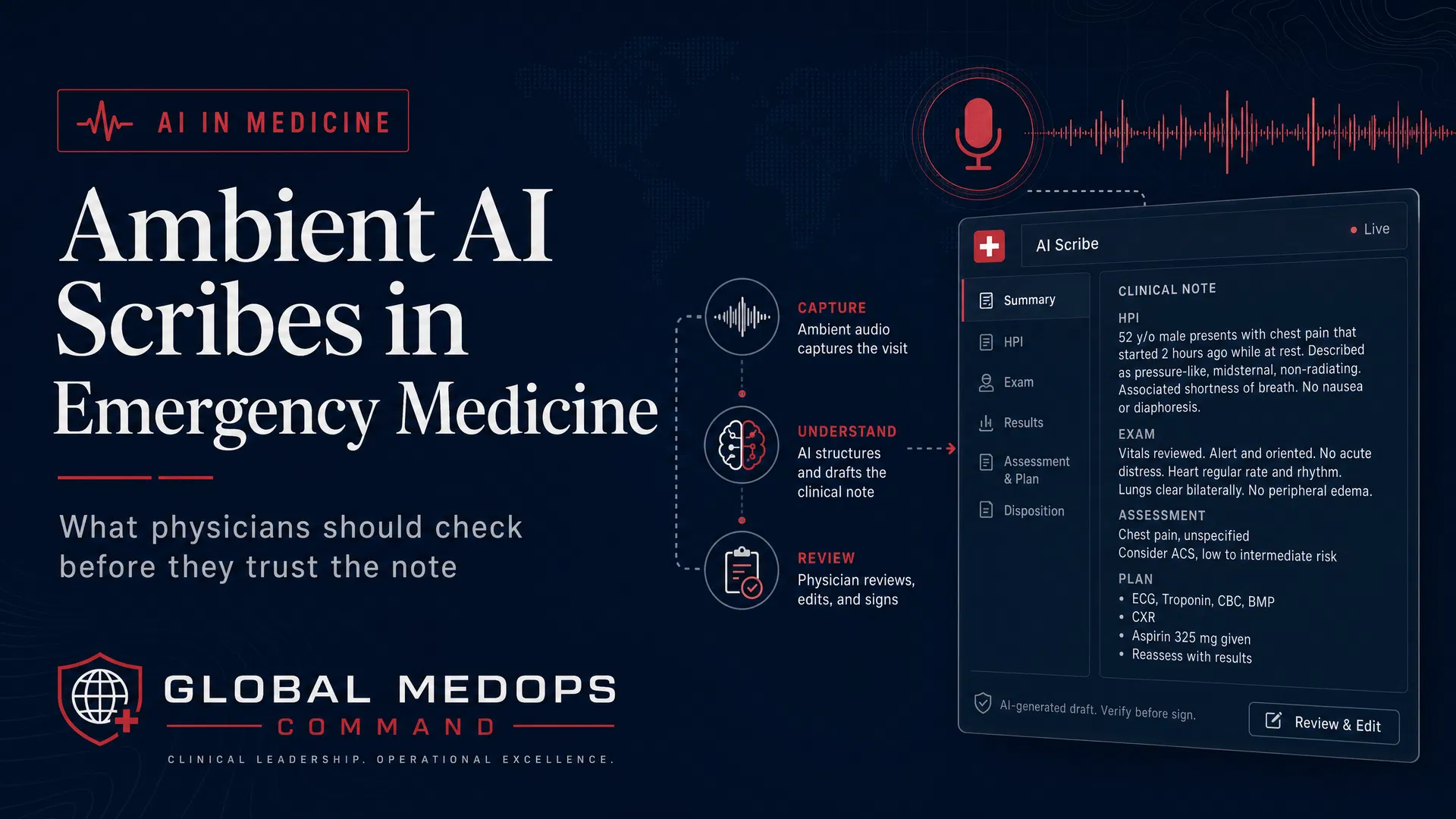
Ambient AI Scribes in Emergency Medicine: What Physicians Should Check Before They Trust the Note
Why this matters
A practical physician-led checklist for emergency clinicians evaluating ambient AI scribes, documentation safety, workflow fit, and note-review risk before adoption.
Recommended next step
Pair this article with the free guide or course store if you want a more structured framework you can apply at the bedside or in leadership conversations.
Ambient AI scribes are getting attention in emergency medicine for a simple reason: documentation consumes time, fragments listening, and often follows physicians home after the shift. The appeal is obvious. A tool that can draft the note while the physician stays focused on the patient sounds like a meaningful operational upgrade.
That promise is real enough to take seriously, but it is also exactly why emergency physicians should slow down before they trust the output. In the emergency department, the note is not a passive summary. It supports billing, continuity, communication, medicolegal review, and sometimes the reconstruction of what happened in a high-acuity case. A tool that saves time but introduces drift into the history, exam, reassessment, or medical decision-making can create new risk even while it reduces keyboard time.
Why emergency physicians are paying attention
The best argument for an ambient AI scribe is not novelty. It is attention. If a clinician spends less cognitive bandwidth typing, navigating templates, and rebuilding conversations from memory, there is more room to listen, examine, explain, and decide. In a busy emergency department, even modest relief in documentation friction can improve throughput, reduce after-hours charting, and make patient conversations feel less divided.
That operational upside is strongest when the tool fits the physician’s actual workflow. Emergency clinicians do not document one predictable encounter type. They move across chest pain, trauma, behavioral health, sepsis, procedures, and reassessments under constant interruption. A scribe that performs well in low-complexity outpatient visits may behave very differently in the rapid, nonlinear reality of emergency care.
What should be checked before trust is given
The first question is not whether the note reads smoothly. The first question is whether it is accurate in the places that matter most. Emergency physicians should pressure-test how the tool handles time stamps, reassessments, critical negatives, differential framing, shared decision-making language, procedure details, and disposition reasoning. A polished paragraph can still hide missing logic.
The second question is whether the draft makes the physician’s thinking clearer or merely longer. Some AI-generated notes sound complete while burying the key medical reasoning under generic phrasing. If the note makes it harder to see why the clinician ruled out a dangerous diagnosis, escalated care, or chose a discharge plan, the tool is not helping the chart even if it adds words.
The third question is how much editing the physician still has to do. A tool that produces a glamorous demo note but requires heavy repair during real shifts may not be saving time at all. In emergency medicine, the operational target is not a beautiful draft. It is a trustworthy draft that reduces friction without increasing review burden.
A practical pilot checklist
A disciplined pilot should start with a narrow use case. Choose a small group of physicians, define a limited rollout period, and compare the tool against real-world goals such as after-shift documentation time, note quality, physician trust, and patient interaction. Review a sample of charts manually instead of assuming the output is safe because it sounds professional.
The review should look at concrete failure modes. Did the note invent elements of the review of systems? Did it flatten uncertainty into false certainty? Did it overstate what was discussed with the patient? Did it omit why discharge was reasonable? These are the kinds of failures that matter in emergency medicine because the chart is often read later by someone who was not there.
A useful governance approach also asks when the tool should not be used. High-acuity resuscitations, behavioral emergencies, trauma activations, interpreter-heavy encounters, or emotionally complex conversations may require a different standard. Responsible adoption includes deciding where the tool adds value and where it should stay out of the room.
Questions worth asking vendors and internal leaders
Emergency physicians should ask whether the tool is tuned for ED note structure, whether it performs differently by encounter type, how it handles corrections, what audit trail exists after edits, and how the organization plans to monitor failure patterns over time. Ask what counts as a successful rollout before the pilot begins. If no one can answer that clearly, the project is not operationally mature.
It is also worth asking whether the local implementation plan includes resident education, attending oversight, and specific expectations for sign-off. Ambient documentation should not create a culture where physicians are told to “just review it quickly.” The last mile still belongs to the clinician.
A better next step than blind enthusiasm
Ambient AI scribes are worth exploring in emergency medicine, but they should be treated like a clinical workflow tool rather than a magic layer over charting. The practical question is whether the system improves documentation quality, preserves judgment, and gives physicians time back without creating new downstream repair work.
If you want a broader framework for evaluating emergency-medicine AI tools beyond documentation, start with the AI Bulletproof course, browse the books and resources, or use the contact page when your department needs speaking, advising, or implementation support.
Keep reading
Related reading and your next step.
Ready to go further? Move from this article into structured training, scenario-based rehearsal, and more physician-written guidance.
Course
Translate the article into a repeatable framework
Use the physician-led course when you want a structured framework for evaluating AI tools, protecting clinical judgment, and leading implementation decisions.
Simulation
Practice the decision path under pressure
Use EM-Sim when you want scenario-based repetition that turns article-level insight into physician-facing emergency-medicine reps.
Blog
Browse more articles
Explore the full blog for more on AI in emergency medicine, then head to the course and simulation pages when you want the structured next step.
Related Articles
AI in Emergency Medicine
The AI ECG Is a Second Reader, Not a Rule-Out Test
AI-assisted ECG can surface hidden ischemic patterns, but it cannot replace a clinician’s read, serial testing, or bedside judgment. Build the workflow around disagreement and false reassurance.
AI in Emergency Medicine
AI Drug-Interaction Checkers Aren’t Clinical Pharmacology: A Safer ED Workflow
General-purpose AI can surface drug-interaction questions, but it cannot replace medication reconciliation, an approved reference, or pharmacist and physician judgment in the ED.
AI in Emergency Medicine
When the ED AI Goes Dark: Build the Downtime Drill Before Go-Live
An ED AI outage is a clinical transition, not only an IT incident. Use five tests to recognize failure, switch to a safe fallback, reconcile the record, and train the team before the next shift depends on it.