Operations
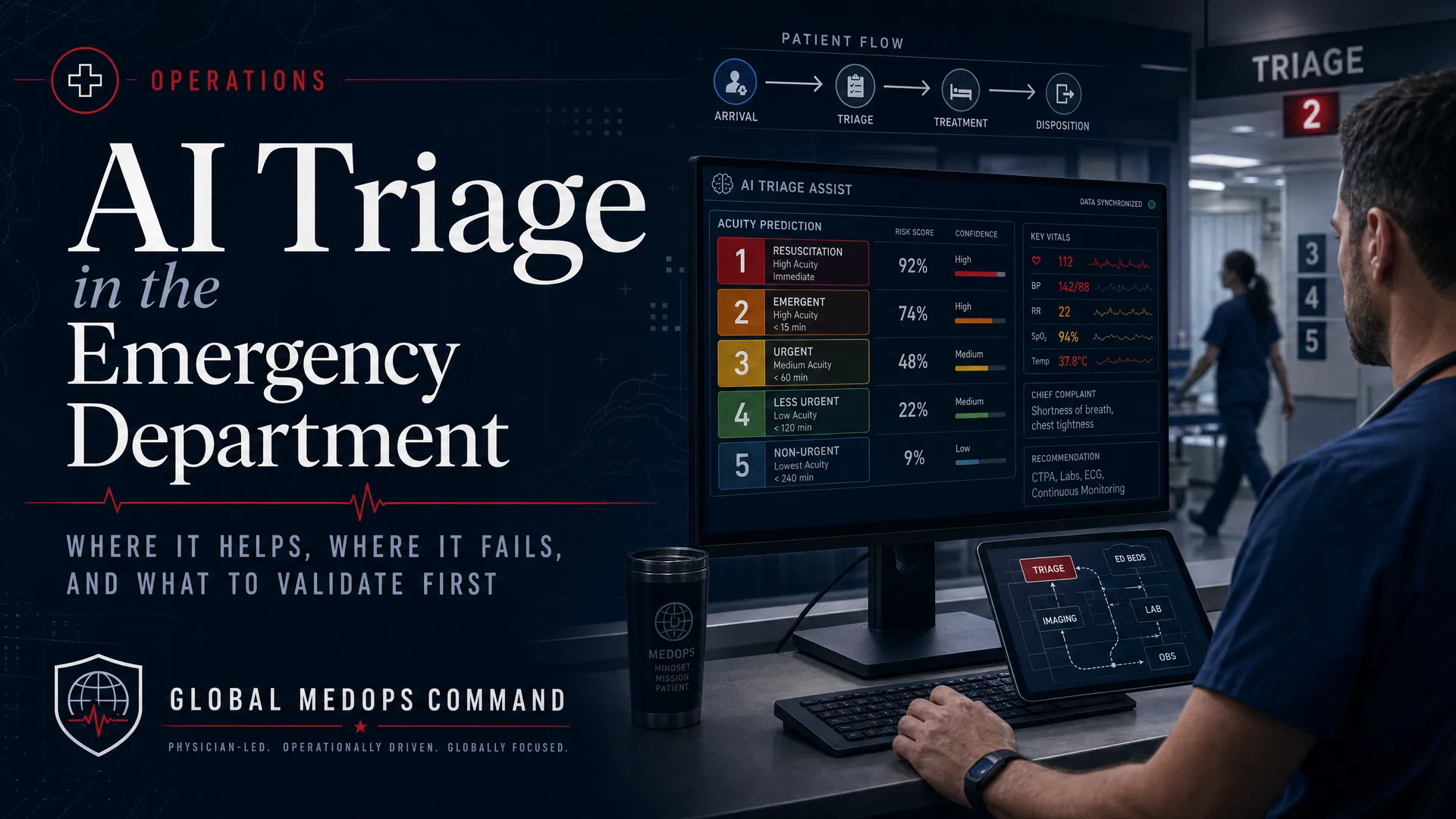
AI Triage in the Emergency Department: Where It Helps, Where It Fails, and What to Validate First
Why this matters
A practical emergency physician framework for evaluating AI triage tools, validating performance, and spotting the failure modes that matter before frontline rollout.
Recommended next step
Pair this article with the free guide or course store if you want a more structured framework you can apply at the bedside or in leadership conversations.
AI triage has become one of the most tempting promises in emergency care. The logic is easy to understand. If artificial intelligence can help identify who is sicker, who needs faster escalation, or who may deteriorate unexpectedly, emergency departments might reduce delay, improve throughput, and target scarce attention where it matters most.
But triage is exactly the kind of workflow where a persuasive tool can become dangerous if clinicians mistake early promise for operational reliability. In emergency medicine, triage is not just a prediction problem. It is a judgment problem shaped by limited information, crowded rooms, evolving physiology, and the real behavior of staff, patients, and systems under pressure.
Where AI triage can genuinely help
The most realistic case for AI triage is not that it replaces triage nurses or physician judgment. It is that it supplements them. A well-built tool may help surface patterns humans miss consistently, especially when volumes are high and cognitive load is rising. It may help flag patients whose vital signs, chief complaint patterns, or prior data suggest elevated risk even when the initial presentation feels deceptively ordinary.
AI can also support operational awareness by identifying clusters of risk, highlighting patients who may merit earlier re-evaluation, and helping leaders see where triage decisions drift across shifts or sites. Used that way, it becomes part of a broader safety and operations picture rather than a silent oracle.
Where it fails in the real emergency department
The failure modes are not subtle. A triage model may look strong on retrospective data yet underperform when patient mix changes, when workflow changes, or when data are missing in the first few minutes of care. It may over-prioritize measurable signals and underweight the clinical intuition that comes from seeing a patient, hearing family concern, or noticing behavior that is hard to encode.
A more dangerous problem is false confidence. Once a tool is presented with scores, colors, or risk labels, humans can start anchoring on it. That means a mediocre system can still influence care simply because it appears quantitative. In crowded departments, the risk is not only that the model is wrong. It is that the model changes how people feel about being wrong.
Another common failure is poor local validation. A tool developed in one system may not generalize to another with different acuity, registration processes, staffing, boarding patterns, or patient demographics. Emergency departments should be suspicious of any pitch that treats triage as if it were operationally identical everywhere.
What to validate before rollout
Start with the use case. Is the tool meant to support nurse triage, physician-in-triage decisions, waiting-room reassessment, or escalation alerts after placement? A tool without a tightly defined role will be impossible to evaluate honestly.
Next, identify the actual outcome being predicted. ICU admission, admission in general, short-term deterioration, or time-sensitive condition recognition are not interchangeable. A model can look impressive on one endpoint and still be clinically unhelpful for the decision the team is trying to make at triage.
Then review performance where failure hurts most. How does the system behave with older adults, language barriers, atypical presentations, behavioral health, chest pain, sepsis, stroke, and low-frequency high-consequence complaints? If the validation story only highlights average performance, it is probably hiding the places where emergency clinicians most need clarity.
A safer pilot structure
A good pilot keeps the tool advisory rather than decisive at first. It compares clinician judgment with model output, measures discordant cases, and performs case review on the misses. It also watches for workflow side effects. Did the tool create alert fatigue? Did it slow down triage conversations? Did it increase over-triage enough to create downstream congestion?
Departments should define stop rules in advance. If the tool repeatedly misclassifies a certain category of patient, if staff do not trust it, or if it increases noise without improving escalation quality, pausing the pilot is a mark of discipline, not failure.
The better mindset for emergency leaders
AI triage should be evaluated as an operational support tool that requires local evidence, local governance, and ongoing review. Emergency clinicians do not need to be anti-AI to be skeptical. They simply need to remember that triage decisions occur in a setting where a small miss can carry a large consequence.
If your team is trying to think more clearly about AI risk, physician oversight, and practical implementation in emergency care, start with the free guide, review the AI Bulletproof course, and use the simulation lab when you want scenario-based practice around high-pressure decision-making.
Keep reading
Related reading and your next step.
Ready to go further? Move from this article into structured training, scenario-based rehearsal, and more physician-written guidance.
Course
Translate the article into a repeatable framework
Use the physician-led course when you want a structured framework for evaluating AI tools, protecting clinical judgment, and leading implementation decisions.
Simulation
Practice the decision path under pressure
Use EM-Sim when you want scenario-based repetition that turns article-level insight into physician-facing emergency-medicine reps.
Blog
Browse more articles
Explore the full blog for more on AI in emergency medicine, then head to the course and simulation pages when you want the structured next step.
Related Articles
AI in Emergency Medicine
The AI ECG Is a Second Reader, Not a Rule-Out Test
AI-assisted ECG can surface hidden ischemic patterns, but it cannot replace a clinician’s read, serial testing, or bedside judgment. Build the workflow around disagreement and false reassurance.
AI in Emergency Medicine
AI Drug-Interaction Checkers Aren’t Clinical Pharmacology: A Safer ED Workflow
General-purpose AI can surface drug-interaction questions, but it cannot replace medication reconciliation, an approved reference, or pharmacist and physician judgment in the ED.
AI in Emergency Medicine
When the ED AI Goes Dark: Build the Downtime Drill Before Go-Live
An ED AI outage is a clinical transition, not only an IT incident. Use five tests to recognize failure, switch to a safe fallback, reconcile the record, and train the team before the next shift depends on it.