AI in Emergency Medicine
AI in the Military Medical Environment: What Civilian EDs Should Be Watching
Why this matters
The DHA rolled ambient AI to every military hospital this year. DARPA wants autonomous battlefield medics by 2028. Civilian EM is the downstream.
Recommended next step
Pair this article with the free guide or course store if you want a more structured framework you can apply at the bedside or in leadership conversations.
The Defense Health Agency began piloting ambient clinical documentation AI in October 2025 and announced this spring that the tool will roll out to every military hospital and clinic in 2026. The Department of War announced classified-network deployment agreements with eight major AI companies in May. The President signed National Security Presidential Memorandum 11 on June 5, 2026, formalizing the integration of frontier AI into defense and intelligence infrastructure. DARPA launched the Medics Autonomously Stopping Hemorrhage program in May with a 24-month window to field-ready prototypes for autonomous battlefield trauma care. The Army ran a $999,000 AI-Assisted Triage prize challenge that drew 198 commercial submissions, evaluated the top six vendors at the Sword 2026 exercise in Poland from May 9 through May 14, and is now positioning the technology for transition to an Army program of record.
The pace and scale of military medical AI deployment in the spring of 2026 is unlike anything happening in civilian emergency medicine, and the civilian specialty needs to be paying attention. The military medical environment is functioning as the high-stakes laboratory for clinical AI integration. The governance frameworks the military is building this year will shape the civilian frameworks the next five years. The procurement structures, the training pipelines, the autonomy thresholds, and the failure-mode documentation that the Defense Health Agency and the Department of War develop will be the templates the civilian sector inherits, modifies, and operationalizes. Emergency physicians who do not understand what is happening in the military medical AI environment in 2026 will be evaluating civilian tools in 2028 without the context that the military's experience would have provided.
What the Military Is Actually Building
The military AI medical stack in 2026 has three layers, and emergency physicians should understand the architecture of each.
The first layer is administrative and clinical documentation AI in fixed military treatment facilities. The DHA's ambient scribe pilot, launched in October 2025, is the same category of tool that civilian emergency departments have been deploying for two years — but the scale and the governance posture are different. The DHA is rolling the tool to every military hospital and clinic in 2026, with centralized governance, standardized AI literacy training for clinicians, and explicit policies on acceptable use, sensitive-data handling, and audit logging. A DHA leader described the architecture at the Red Hat AI ecosystem briefing in early June: an AI firewall to block prompts containing sensitive data, mandatory model cards and data cards for every vendor, banners and notifications of acceptable use in the user interface, and proactive citation of sources when the tool surfaces a response that may not be entirely accurate. That is the governance posture civilian institutions have been told they need and have largely failed to build. The military is building it because the consequences of getting it wrong inside the DoD are immediate and operational, not just regulatory.
The second layer is decision support and predictive analytics. The Army's AI-Assisted Triage challenge is the visible example. Portable, network-enabled trauma sensors with predictive alerts for life-threatening physiological conditions, evaluated in a live operational exercise in Poland, with performance data feeding the Army's program-of-record transition decision. The selection process is rigorous: 198 submissions filtered through white papers, virtual pitches, and operational demonstration before six finalists were funded. The contrast with the typical civilian hospital procurement process — vendor demonstration, committee review, contract — is instructive. The military is running the procurement as a validated comparative effectiveness study. The civilian sector should be doing the same and largely is not.
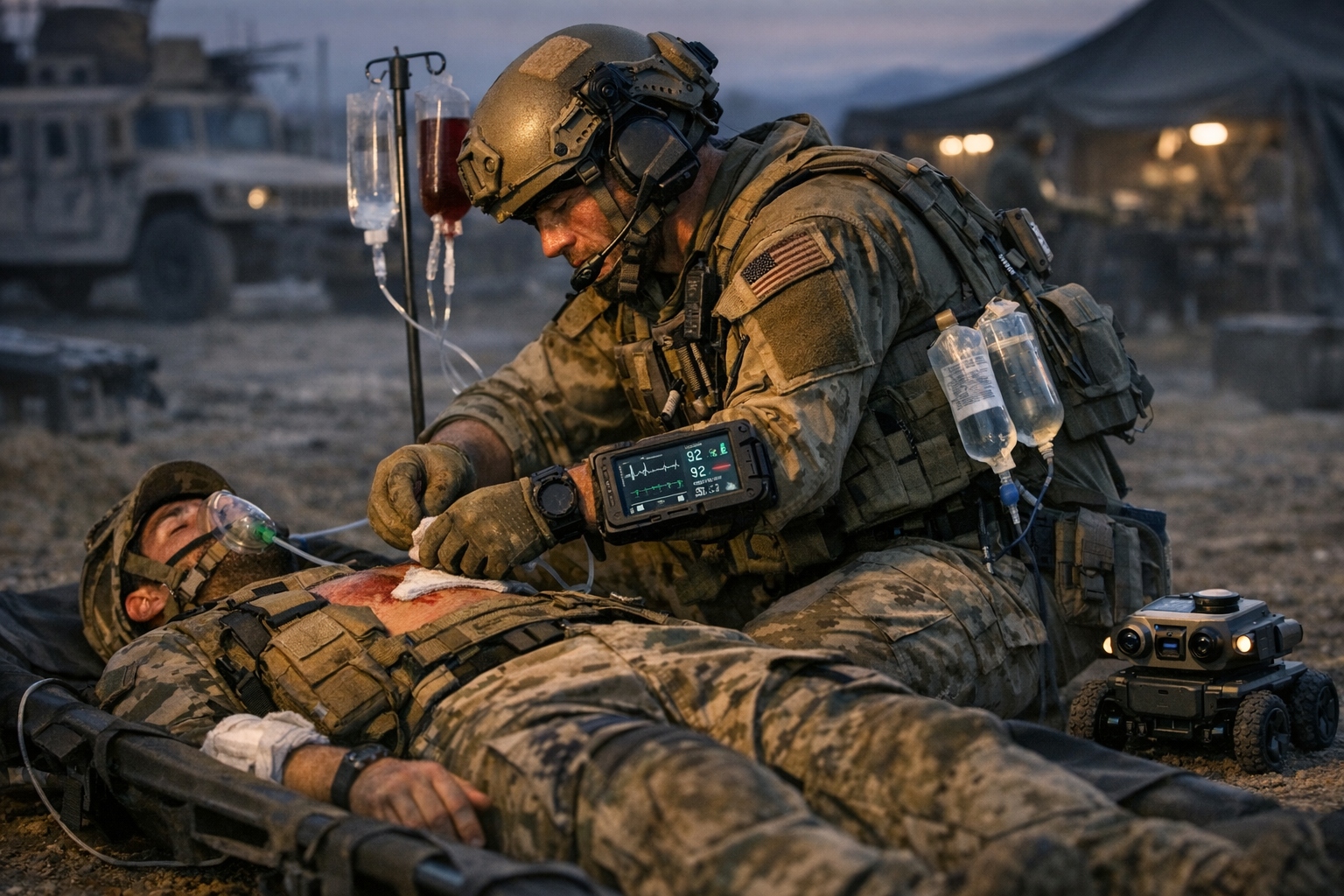
The third layer is autonomous clinical intervention. DARPA's MASH program is the leading example, and it is the most consequential of the three for what it implies about the future of clinical AI governance. The program target is non-compressible torso hemorrhage, the leading preventable cause of combat death, and the architecture is autonomous swarm robots that locate casualties, assess wounds, and deliver trauma care with no human direction. Phase 1 begins this summer; the 24-month timeline puts field-ready prototypes at mid-2028. Whether or not the program produces a fielded system on that schedule, it represents a formal DARPA procurement category for autonomous clinical decision-making — the first time the U.S. government has explicitly funded the development of clinical AI tools intended to operate without a human clinician in the loop in a high-acuity care environment. The international humanitarian law implications, the FDA regulatory implications, and the civilian-spillover implications of that procurement category will shape clinical AI governance for the next decade.
Why Civilian EM Should Care
Emergency physicians who serve in the military medical environment — and I am one — see the spillover patterns clearly. The training pipelines the military uses to bring its clinicians up to AI literacy will inform the civilian residency curriculum within five years. Operation Bushmaster at the Uniformed Services University, where providers practice tactical combat casualty care under realistic operational conditions, is already integrating AI-augmented decision support into the scenario set. The simulation-based training infrastructure that supports that integration is the same kind of infrastructure that civilian residency programs and EMS services need to build. For the simulation framework that supports clinician-level competency with AI-augmented prehospital and emergency care, see emsmedsim.globalmedopscommand.com.
The governance structures the DHA is building — the AI firewall, the model card and data card requirements, the AI literacy training, the audit logging, the banner-and-notification user-interface conventions — will be the templates that civilian health systems adopt as the Joint Commission's AI guidance, the AMA's AI literacy policy, and the EU AI Act's high-risk-system requirements mature into actionable standards. The civilian institution that builds its governance framework in 2027 will be building it on top of the military's 2026 experience whether the civilian leadership recognizes it or not.
The autonomous-intervention category is the most important spillover to watch. The DARPA MASH program is procuring autonomous clinical AI for the battlefield, but the underlying technologies — autonomous wound assessment, autonomous hemorrhage control, autonomous medication administration — have civilian translations. The civilian emergency medical services that operate in austere environments, the rural emergency departments with limited specialist coverage, the disaster response systems that have to scale up faster than human staffing allows — all of those settings are plausible secondary markets for autonomous clinical AI within the decade. Emergency physicians who think about military medical AI as a separate domain are missing the line that connects it to the civilian decision they will be making in five years about whether to deploy an autonomous tool in their own department. The governance and the override frameworks I have written about elsewhere — including in my Medium essay on Why Emergency Physicians Make the Best AI Governance Leaders — translate directly into the military-derived governance frameworks the civilian sector will inherit.
What the Military Is Getting Right That Civilian EM Should Copy
Three patterns are worth importing immediately.
The first is the operational evaluation methodology. The Army's $999K prize challenge, the two-phase selection process, the live operational demonstration in Poland, and the program-of-record transition decision based on validated performance data is a procurement architecture every large civilian health system should be considering for high-stakes clinical AI tools. The committee-review-and-vendor-demo model is insufficient for tools that will operate in the resuscitation bay. The civilian sector should be running comparative effectiveness exercises against representative patient populations before signing the contract.
The second is centralized AI literacy training tied to the deployment timeline. The DHA is not deploying ambient AI to every military hospital and clinic in 2026 without simultaneously deploying the literacy training that closes the gap between the tool's capabilities and the clinician's mental model of its capabilities. The civilian sector has consistently deployed tools faster than the training, and the override patterns are the data that shows the cost. Tying the training to the deployment timeline is institutional discipline, not regulatory burden.
The third is the explicit acceptable-use architecture in the user interface. Banners, notifications, accuracy disclaimers, source citations, and AI-firewall blocks on sensitive-data prompts are not luxuries. They are the institutional infrastructure that operationalizes the AI literacy the clinician has been trained in. The civilian electronic health record vendors are years behind the DHA on this, and the civilian institutions that demand the same architecture from their vendors will be operating with a meaningfully different safety margin than the institutions that accept the vendor's default.
Dr. Chet's Take
I have served as the State Surgeon for the Army National Guard for years and have watched the military medical environment integrate technology under pressure that the civilian sector rarely sees. The pattern is consistent. The military identifies an operational problem, mobilizes the procurement architecture to solve it, builds the governance infrastructure in parallel with the technology deployment, and trains the workforce on the integrated package. The civilian sector watches, lags, and eventually inherits the framework. That pattern is now playing out in clinical AI with unprecedented speed and scale. The DHA, DARPA, the Army, and the Department of War are doing in 2026 what the civilian healthcare system will be trying to catch up to in 2030.
Emergency physicians who serve in the Reserve Component, the National Guard, or active military medicine are uniquely positioned to translate the military experience into civilian practice. The rest of the specialty should be reading the same primary sources — the DHA briefings, the DARPA solicitations, the Army's program-of-record transitions, the Department of War's classified-network deployment agreements — and asking what the institutional implications are for civilian emergency medicine. The military medical AI environment is the laboratory. The civilian sector is the downstream. The five-year window in which the civilian leadership can shape its own integration is open, and it is open in significant part because the military is running the high-stakes experiments now.
AI Won't Wait. Neither Should You.
If your emergency department's AI integration plan does not look at the military medical environment as a primary input — the DHA's governance posture, the Army's operational evaluation methodology, the DARPA autonomous-intervention category — your plan is missing the leading indicator the entire civilian sector will be reacting to within five years. Consider enrolling in my course: AI in Emergency Medicine: Becoming AI Bulletproof. The course walks through the procurement, governance, training, and override frameworks that the military experience is now informing, and the version of civilian AI integration that incorporates those lessons rather than reinventing them.
If you're an emergency physician (or any clinician treating patients daily) trying to understand how AI will actually impact your clinical practice — not just the hype — I put together a free practical guide. You can download it here: AI in EM Survival Guide.
Dr. Chester "Chet" Shermer, MD, FACEP is a Professor of Emergency Medicine, TeleHealth, HEMS and Critical Care Transport, and State Surgeon for the Army National Guard. He is the founder of Global MedOps Command and the creator of AI in Emergency Medicine: Becoming AI Bulletproof.
Also on Medium: Read more from Dr. Shermer on Medium
Sources
- Military Health System, "Military Health System integrates AI into medical education," May 2026, https://www.health.mil/News/Dvids-Articles/2026/05/21/news565866
- The White House, "Fact Sheet: President Donald J. Trump Signs Historic Directive on AI in the National Security Enterprise" (NSPM-11), June 2026, https://www.whitehouse.gov/fact-sheets/2026/06/fact-sheet-president-donald-j-trump-signs-historic-directive-on-ai-in-the-national-security-enterprise/
- Defense News, "DARPA launches search for robot medics to treat battlefield casualties" (MASH program), May 2026, https://www.defensenews.com/industry/techwatch/2026/05/26/darpa-launches-search-for-robot-medics-to-treat-battlefield-casualties/
- U.S. Army Acquisition, "Accelerating Lifesaving Tech Through the Army's Innovation Engine" (AI-Assisted Triage prize challenge), June 2026, https://www.army.mil/article-amp/293070/accelerating_lifesaving_tech_through_the_armys_innovation_engine
- Defense Health Agency, "Building the Military Health System's AI Ecosystem," briefing, June 2026, https://www.youtube.com/watch?v=tnOjVyjycnk
- TRICARE, "AI and TRICARE: Coverage and Technology Guide (2026)," May 2026, https://tricare.com/entry/artificial-intelligence
Keep reading
Related reading and your next step.
Ready to go further? Move from this article into structured training, scenario-based rehearsal, and more physician-written guidance.
Course
Translate the article into a repeatable framework
Use the physician-led course when you want a structured framework for evaluating AI tools, protecting clinical judgment, and leading implementation decisions.
Simulation
Move the lesson into readiness reps
Use MilMedSim when this article points toward TCCC rehearsal, operational decision-making, or military medical readiness training.
Blog
Browse more articles
Explore the full blog for more on AI in emergency medicine, then head to the course and simulation pages when you want the structured next step.
Related Articles
AI in Emergency Medicine
AI Fracture Detection in the ED: What the Evidence Supports
AI fracture tools make clinicians more sensitive in reader studies, and NICE allows four of them under conditions. No randomized trial has yet published patient outcomes. How to deploy one as a second reader.
ED Management
Left Without Being Seen: What Emergency Physicians Can Actually Fix
Patients who leave without being seen come back more often, and the front end that drives most walkouts is the part an emergency physician can redesign. Here is what the evidence supports.
AI in Emergency Medicine
AI for ED Staffing: Forecasts Are Not Shift Plans
AI can forecast emergency department arrivals, but a patient count is not a staffing plan. Learn how to validate forecasts, keep human control, and test a safer workflow.