AI in Emergency Medicine
AI in Emergency Medicine: The Guide for the Modern Clinician
Why this matters
Master AI in EM. From predictive triage to prompt improvement, learn how to become an AI-bulletproof clinician in the modern emergency department.
Recommended next step
Pair this article with the free guide or course store if you want a more structured framework you can apply at the bedside or in leadership conversations.
The New Era of AI in Emergency Medicine: Beyond the Hype
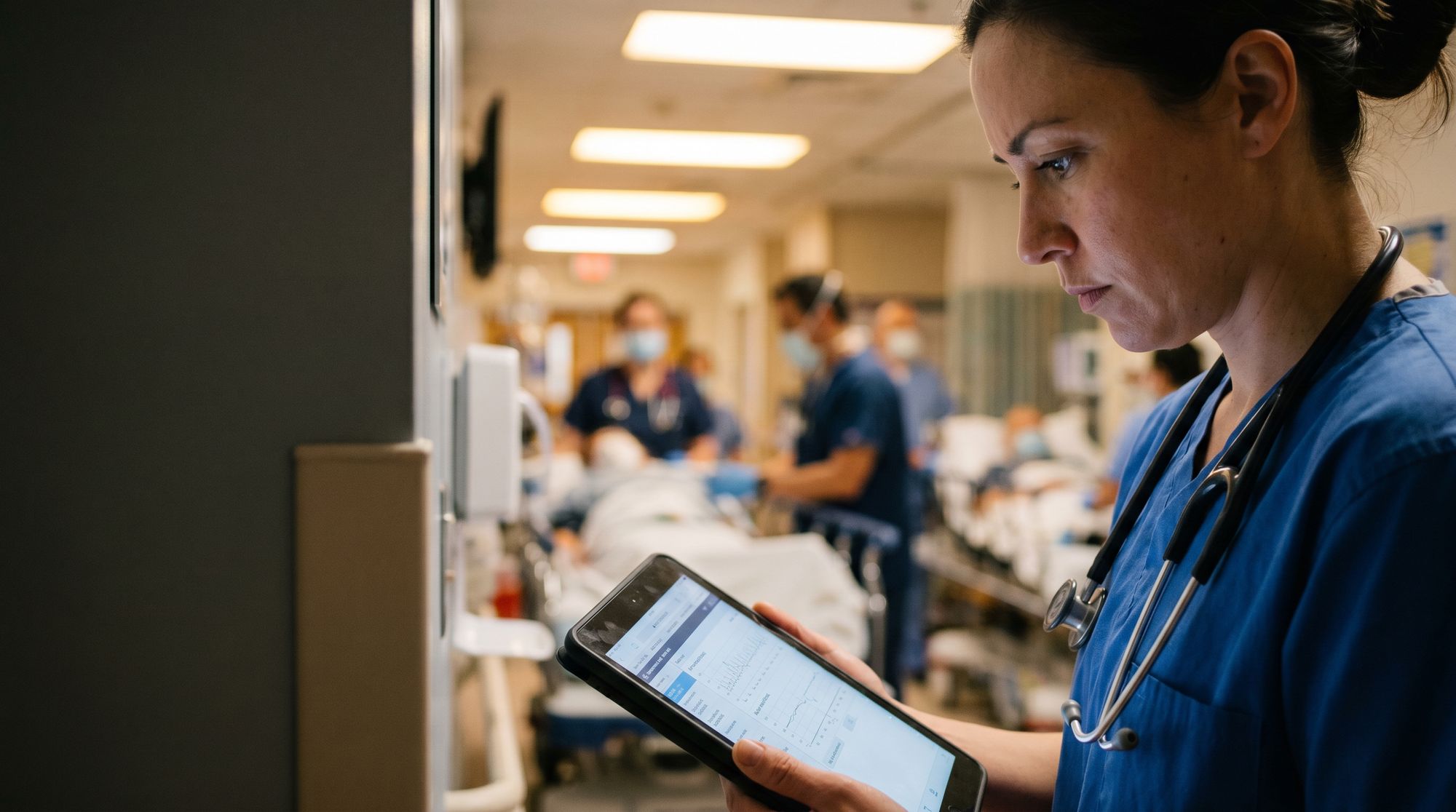
Picture this: it's 2:47 a.m., your department has 38 patients in 22 beds, and the triage nurse is flagging a chest pain with an atypical presentation that doesn't quite fit your clinical gestalt. A machine learning model quietly surfaces a sepsis risk score in the background. Do you trust it? Override it? You haven't thought about it yet — and that's the problem.
Artificial intelligence in emergency medicine is not a future scenario. It's the floor you're already standing on.
The shift is already underway. Traditional clinical scores — HEART, CURB-65, Wells — were built on regression models and expert consensus. They were a starting point. Machine learning models trained on millions of encounters don't follow the same logic, and they don't need to. They find patterns humans can't. That's not threatening. That's useful — if you understand what you're working with.
Emergency medicine is the perfect stress test for any AI technology. High acuity, time compression, diagnostic ambiguity, and population heterogeneity all converge in one place. No controlled trial replicates what happens between 0200 and 0600 on a Saturday. If AI performs in the emergency department, it performs anywhere. According to an ACEP member survey, 80% of emergency physicians believe AI will improve diagnostic accuracy — yet only 11% feel they've received adequate training to use it. That gap is where harm lives.
There's also a distinction that matters enormously in practice: automation replaces a decision; clinical decision support informs one. The goal of this resource is not to make you dependent on tools you don't understand. It's the opposite. The AI-bulletproof clinician commands the technology — not the other way around.
Before mastery comes vocabulary. The next section breaks down the core terminology of med-AI, starting with the concepts that carry the most clinical and legal weight.
Core Terminology: Speaking the Language of Med-AI
Artificial intelligence in emergency medicine means nothing if you can't evaluate what the machine is actually doing. Before you assess any clinical decision support tool, ambient charting platform, or imaging algorithm, you need command of the vocabulary. These aren't buzzwords — they're the categories that separate genuine clinical utility from expensive noise.
Natural Language Processing (NLP)
A branch of AI that allows machines to interpret, structure, and generate human language. In the emergency department, NLP powers ambient charting systems that listen to a patient encounter and auto-populate the medical record — reducing documentation burden without breaking clinical flow.
Predictive Analytics
Statistical modeling that uses historical and real-time patient data to forecast a clinical outcome. Predictive analytics tells you which patient is trending toward sepsis or which chest pain is likely to need admission — based on patterns, not intuition alone.
Generative AI
Systems trained to produce original content — text, images, or clinical summaries — rather than classify existing data. Generative AI drafts discharge instructions and synthesizes chart narratives. It does not predict; it creates. Conflating it with predictive analytics is a common and consequential mistake.
Computer Vision
AI trained to analyze visual inputs, including radiographs, CT scans, and point-of-care ultrasound images. In a high-volume emergency department, computer vision tools can flag pneumothorax or intracranial hemorrhage in seconds, functioning as a parallel read before the radiologist weighs in.
Explainable AI (XAI)
A design standard requiring that an AI system's recommendation be traceable and interpretable by the clinician receiving it. As the CEEM Journal makes clear, XAI is non-negotiable in emergency medicine — because if you can't follow the machine's logic, you can't own the clinical decision, and you can't defend it.
Terminology is only the starting point. Understanding what these systems claim to do is one thing — knowing where they're deployed first, and what they get wrong, is the harder skill. That's exactly where triage begins.
Triage and Risk Stratification: The Predictive Frontline
AI in the emergency department is reshaping triage from a snapshot assessment into a continuous, predictive process — and that shift demands your active supervision.
The most consequential decision made at the front door isn't a diagnosis. It's a disposition question: does this patient go home or get admitted? Historically, that judgment relied on a nurse's gestalt, a brief history, and a set of vitals. Now, machine learning models are analyzing dozens of variables simultaneously — chief complaint, vital sign trends, past utilization, lab values — to generate a risk-stratified prediction before a physician ever lays eyes on the patient. Research indicates that AI models can achieve high accuracy in predicting patient disposition from the ED. That's a clinically meaningful signal.
Beyond disposition, early warning algorithms for sepsis and clinical deterioration are now embedded in many hospital systems. These tools flag subtle physiologic drift — a trending lactate, a narrowing pulse pressure, an escalating respiratory rate — hours before a human would recognize the pattern. The response time advantage alone saves lives.
The promise carries a real risk. Algorithmic bias in triage is not theoretical — it's documented. Models trained on historical data inherit historical inequities. Undertriage of certain populations, misclassification of atypical presentations, and over-reliance on surrogate variables all become encoded errors at scale. If you're working with one of these systems, understanding its training data and validation population isn't optional — it's your professional obligation. Practical simulation-based training, like AI-integrated clinical scenarios, helps build the critical evaluation skills these tools demand.
The algorithm offers a probability, but you make the call.
With triage models now handling the predictive front end, the next logical application lives in imaging — where AI is beginning to change how we see what we'd otherwise miss.
Diagnostic Imaging: The AI Radiologist's Assistant
In emergency medicine AI, the most mature and widely deployed application isn't in triage or documentation — it's in the reading room. Machine learning for diagnostic imaging interpretation is currently one of the most widely adopted applications in academic medical centers, and for good reason. The stakes are high, the volume is punishing, and the cost of a missed finding is often irreversible.
That being said, the AI here isn't replacing radiology. It's functioning as an always-on second set of eyes — one that doesn't fatigue at 3 a.m.
The core value proposition is miss-rate reduction at scale. In high-volume emergency departments, critical findings buried in a queue of 200 overnight scans are a real and documented problem. AI flagging systems prioritize worklists, surfacing probable intracranial hemorrhages and pulmonary emboli before a radiologist has even opened the study. That's not a convenience — it's a patient safety mechanism.
Here's where current FDA-cleared tools are operating:
Trauma
Automated detection of intracranial hemorrhage on non-contrast CT
Identification of midline shift and mass effect
Fracture detection in high-throughput trauma workflows
Cardiac
Left ventricular dysfunction flagging on echocardiography
Detection of pericardial effusion
AI-assisted interpretation of ST-segment changes on ECG
Pulmonary
Pulmonary embolism probability flagging on CT pulmonary angiography
Pneumothorax detection on chest X-ray
Consolidation pattern recognition consistent with pneumonia
The physician remains the final arbiter of the clinical correlate. Every time. An AI flag is a prompt, not a diagnosis. The algorithm doesn't know that your patient is on therapeutic anticoagulation, or that the "consolidation" is a known malignancy. You do.
That distinction — between pattern recognition and clinical reasoning — becomes even sharper when you consider what the next generation of AI tools is attempting: generating differential diagnoses in natural language.
Generative AI and ChatGPT: The Future of Medicine?
Generative AI can generate a 15-item differential in seconds — but an AI-bulletproof clinician knows exactly where that list ends and clinical judgment begins.
Large language models have found a legitimate foothold in emergency medicine. In practice, their highest-value use case is differential diagnosis generation and "second look" support — running a presenting symptom cluster against a vast training corpus to surface diagnoses that a fatigued physician might not immediately consider at 3 a.m. That's a genuine clinical asset.
That being said, the risks in a zero-error environment are not theoretical. Hallucinations — confident, well-structured, and completely wrong outputs — are an existential problem when the stakes are a missed MI or an overlooked aortic dissection. LLMs don't flag uncertainty the way a seasoned clinician does. They generate fluent prose whether the answer is textbook-correct or dangerously fabricated. In a department where a single documentation error can cost a patient their life, fluency without accuracy is a liability, not a feature.
The structural limitation goes deeper than hallucinations. As Dr. Harvey Castro, author of ChatGPT and Healthcare, has noted, AI lacks the "common sense" and contextual awareness required for the chaotic environment of an ER. It cannot integrate the diaphoresis you observed walking to the bedside, the smell of the room, or the patient's affect when they described their chest pain. The physical exam remains entirely outside its reach.
Here's a practical framework for understanding where each strength actually lives:
Generative AI Strengths
Human Clinician Strengths
Broad differential generation
Contextual clinical reasoning
Pattern recall from large datasets
Physical exam interpretation
Consistent, tireless availability
Nonverbal and emotional cues
Documentation drafting support
Ethical judgment under uncertainty
The question isn't whether generative AI belongs in the ED — it does. The question is how you manage it without becoming dependent on it. That same administrative burden driving clinicians away from the bedside is exactly where AI's next wave of tools is targeting its firepower.
Regaining Humanity: Solving the Documentation Crisis
Physician burnout in emergency medicine isn't primarily about the patients — it's about the paperwork that buries you after every encounter.
The average emergency physician spends a staggering portion of each shift not at the bedside but at a workstation, hunting for the right dropdown, correcting auto-populated errors, or assembling discharge instructions that read like insurance disclaimers. The keyboard became the wall between clinician and patient. That wall is coming down.
Ambient voice technology is the most practical near-term application of generative AI in emergency medicine. These tools listen passively during the patient encounter, extract clinically relevant information, and generate a structured note — without the physician ever touching a keyboard mid-visit. According to JAMA research, AI-driven ambient documentation can reduce clinical documentation time by up to 50%. That's not a marginal efficiency gain. That's reclaiming hours every shift.
The documentation burden extends past notes. Discharge instructions are another casualty of time pressure — often templated, rarely personalized, and frequently misunderstood by patients. AI-assisted discharge generation can tailor instructions to diagnosis, literacy level, and follow-up complexity in seconds. Patients leave with something they can actually use. That matters for outcomes.
That being said, the deeper value isn't measured in minutes saved. It's measured in eye contact. When administrative offloading removes the cognitive overhead of charting in real time, the physician is freed to do what no algorithm can replicate: listen, observe, and connect. The human touch isn't a soft metric — it's a clinical tool, and burnout erodes it first.
The efficiency gains from AI don't stop at the bedside, though. The same data that powers documentation tools also feeds something larger — the operational infrastructure that determines how your entire department functions under pressure.
Operational Strategy: AI for Clinical Managers
AI-driven predictive analytics give clinical managers a concrete mechanism to act on surge patterns before the waiting room reaches capacity — not after.
The documentation crisis covered in the previous section affects individual physicians. That being said, the throughput and boarding crisis hits the entire department, and that's where clinical managers carry the heaviest load. AI addresses both simultaneously.
Predictive staffing models analyze historical census data, seasonal illness patterns, local event calendars, and real-time regional factors to forecast patient volume hours in advance. Instead of reacting to a surge mid-shift, you're pre-positioning staff with appropriate lead time. That's a structural advantage, not a marginal one.
Bed management is the second lever. Research confirms that predictive analytics for patient disposition significantly impacts ED boarding times and hospital-wide throughput. AI systems that score admission likelihood at triage — rather than at the point of physician decision — initiate the bed-request process earlier, compressing the entire disposition timeline.
The ROI question is legitimate. Implementation costs are real: licensing, integration, staff training, and workflow redesign. What offsets those costs is throughput. Shorter boarding times mean more available beds, more patients treated per shift, and measurably reduced left-without-being-seen rates — all of which translate directly to revenue and quality metrics.
Here are five Operational KPIs where AI creates measurable impact:
Door-to-provider time — reduced by AI-assisted triage queue management
Boarding hours — compressed through early disposition scoring
Left-without-being-seen rate — lowered when flow acceleration tools are active
Staff overtime costs — reduced through predictive scheduling accuracy
Bed request-to-placement time — shortened by proactive bed management alerts
Knowing which KPIs move is only part of the answer. The harder question is which AI tools are actually ready for live clinical deployment right now — and that's exactly what we'll break down next.
The Best AI Tools for Emergency Medicine Today
Choosing the right AI tool for your ED isn't about finding the most sophisticated algorithm — it's about finding the one that disappears into your workflow.
The current landscape breaks into four functional categories. Triage tools use machine learning to risk-stratify patients at the front door, flagging sepsis and high-acuity presentations before a physician lays eyes on them. Imaging AI assists with rapid interpretation of chest X-rays, CT scans, and point-of-care ultrasound. Documentation platforms generate structured notes from ambient voice capture, directly addressing the burden covered in earlier sections. Education tools use adaptive learning and simulation environments to close competency gaps at scale.
That being said, not every vendor deserves a contract. Before you sign anything, run every candidate through these five questions:
Does it integrate without adding clicks? The best AI is one that integrates seamlessly into existing EHR workflows — Global MedOps Command Strategy makes this a non-negotiable criterion.
What is the validation dataset? Ask where and on whom the model was trained. ED populations vary significantly.
Who owns the data? Understand exactly what patient data leaves your system and where it goes.
What does failure look like? Every model has edge cases. Demand documented error rates and failure modes.
What is the retraining schedule? A static model degrades. Confirm the vendor's update cadence.
No AI tool should go live in a clinical environment without simulation-based training first. A pilot program at one academic medical center demonstrated that structured resident training on AI tools before deployment produced measurably safer adoption outcomes.
The tools available today are genuinely capable. The question is whether your team is prepared to use them correctly — a challenge that becomes even more acute when you move beyond the four walls of the ED entirely.
Military and Prehospital Applications: AI at the Edge
AI deployed at the point of injury — before a physician ever enters the picture — represents the most demanding test case for clinical decision support technology.
The standard ED has infrastructure, staffing ratios, and backup systems. A combat medic managing a casualty in an austere environment has none of that. That asymmetry is exactly why military and prehospital medicine are pushing AI integration harder than almost any other domain.
Prolonged Casualty Care (PCC) is where this pressure hits first. When evacuation is delayed by hours or days, a non-physician provider must make high-stakes clinical decisions far outside their normal scope. AI decision-support tools — integrated into ruggedized devices — now provide real-time physiologic monitoring, fluid resuscitation guidance, and deterioration alerts that extend a medic's effective clinical reach. According to the MilMedSim Scenario Trainer, military operational readiness now formally includes AI integration for decision support in austere environments. That's not aspirational language — it's doctrine.
"The medic doesn't need AI to replace judgment. They need AI to make sure they haven't missed the thing that kills the patient at hour six."
In Mass Casualty Incidents (MCI), autonomous triage algorithms are being tested against the START and SALT systems. Pattern recognition across multiple simultaneous casualties — tracking vitals, injury patterns, and transport priority in real time — reduces the cognitive load on the incident commander at the moment it's highest.
"Triage in a mass casualty event is the most time-compressed decision sequence in medicine. AI doesn't slow that down — it structures it."
Tele-ultrasound guidance closes another critical gap. Remote physician oversight, delivered via AI-assisted image interpretation to a paramedic or combat medic performing a FAST exam, brings diagnostic accuracy to environments where it previously didn't exist.
"When a flight medic can get real-time ultrasound feedback from a physician 400 miles away, the patient's geography stops being a death sentence."
The clinicians who understand these edge-case applications are already thinking differently about what it means to be AI-capable — and that mindset shift is exactly what the next section addresses.
Key Takeaways: The Future of the AI-Enhanced Physician
The New Era of AI in Emergency Medicine: Beyond the Hype
Core Terminology: Speaking the Language of Med-AI
Triage and Risk Stratification: The Predictive Frontline
Diagnostic Imaging: The AI Radiologist's Assistant
Generative AI and ChatGPT: The Future of Medicine?
Last updated: May 24, 2026
For More Information
If you’re an emergency physician (or any clinician treating patients daily) trying to understand how AI will actually impact your clinical practice — not just the hype — I put together a free practical guide. You can download it here: AI in EM Survival Guide
Chester “Chet” Shermer, MD, FACEP is a Professor of Emergency Medicine, TeleHealth, HEMS and Critical Care Transport, and State Surgeon for the Army National Guard. He is the founder of Global MedOps Command and creator of the course AI in Emergency Medicine: Becoming AI Bulletproof. His books — Emergency Department Efficiency Playbook, How to Avoid Becoming an AI Casualty, and The Emergency Medicine Observation Unit — are available on Amazon, Gumroad, and Kajabi. Connect: globalmedopscommand.com | LinkedIn Read more on the GMOC blog.
Keep reading
Related reading and your next step.
Ready to go further? Move from this article into structured training, scenario-based rehearsal, and more physician-written guidance.
Course
Translate the article into a repeatable framework
Use the physician-led course when you want a structured framework for evaluating AI tools, protecting clinical judgment, and leading implementation decisions.
Simulation
Practice the decision path under pressure
Use EM-Sim when you want scenario-based repetition that turns article-level insight into physician-facing emergency-medicine reps.
Blog
Browse more articles
Explore the full blog for more on AI in emergency medicine, then head to the course and simulation pages when you want the structured next step.
Related Articles
AI in Emergency Medicine
AI Fracture Detection in the ED: What the Evidence Supports
AI fracture tools make clinicians more sensitive in reader studies, and NICE allows four of them under conditions. No randomized trial has yet published patient outcomes. How to deploy one as a second reader.
ED Management
Left Without Being Seen: What Emergency Physicians Can Actually Fix
Patients who leave without being seen come back more often, and the front end that drives most walkouts is the part an emergency physician can redesign. Here is what the evidence supports.
AI in Emergency Medicine
AI for ED Staffing: Forecasts Are Not Shift Plans
AI can forecast emergency department arrivals, but a patient count is not a staffing plan. Learn how to validate forecasts, keep human control, and test a safer workflow.