Leadership
AI Governance for Emergency Departments: A Practical Checklist Before You Scale Anything
Why this matters
A practical governance framework for emergency departments evaluating AI pilots, oversight, metrics, escalation rules, and safe scale decisions before widespread rollout.
Recommended next step
Pair this article with the free guide or course store if you want a more structured framework you can apply at the bedside or in leadership conversations.
Many emergency departments are now past the stage of casual AI curiosity. The harder question is no longer whether tools exist. The real question is how leaders decide what to pilot, who reviews the results, what counts as success, and when a pilot should stop instead of scale.
That is where governance matters. Governance sounds administrative, but in emergency medicine it is operational. It determines whether a department adopts AI with discipline or drifts into a collection of loosely supervised tools that produce inconsistent value, uncertain ownership, and preventable risk.
Governance is not bureaucracy for its own sake
A governance framework is useful because emergency departments deal with high-acuity decisions, variable staffing, crowding, and downstream consequences that extend well beyond the moment a tool is used. If a model changes documentation behavior, triage behavior, or escalation behavior, it is changing more than one screen in a workflow. It is altering the way care is delivered and remembered.
Without governance, pilots often expand because enthusiasm outruns evidence. One physician likes a tool, another unit asks for access, the vendor promises an upgrade, and suddenly something provisional begins to feel permanent without a disciplined review of safety, value, or failure modes.
What every governance process should define up front
Start by naming an owner. Every pilot needs a physician leader, an operational counterpart, and a mechanism for case review. If no one owns the tool after the kickoff meeting, the system is already too vague to scale responsibly.
Second, define the exact use case. Is the tool supporting documentation, triage, discharge drafting, inbox summarization, or internal education? A vague promise such as “help physicians with AI” cannot be governed well because it gives reviewers no clear frame for what the tool should or should not do.
Third, decide the metrics before the pilot begins. Those metrics should include both benefit and risk. Time saved, after-hours charting, or workflow adoption are useful, but so are note defects, clinician trust, escalation errors, override patterns, and the burden of correcting output. A tool that improves one metric while degrading three others is not a success story.
A practical emergency department checklist
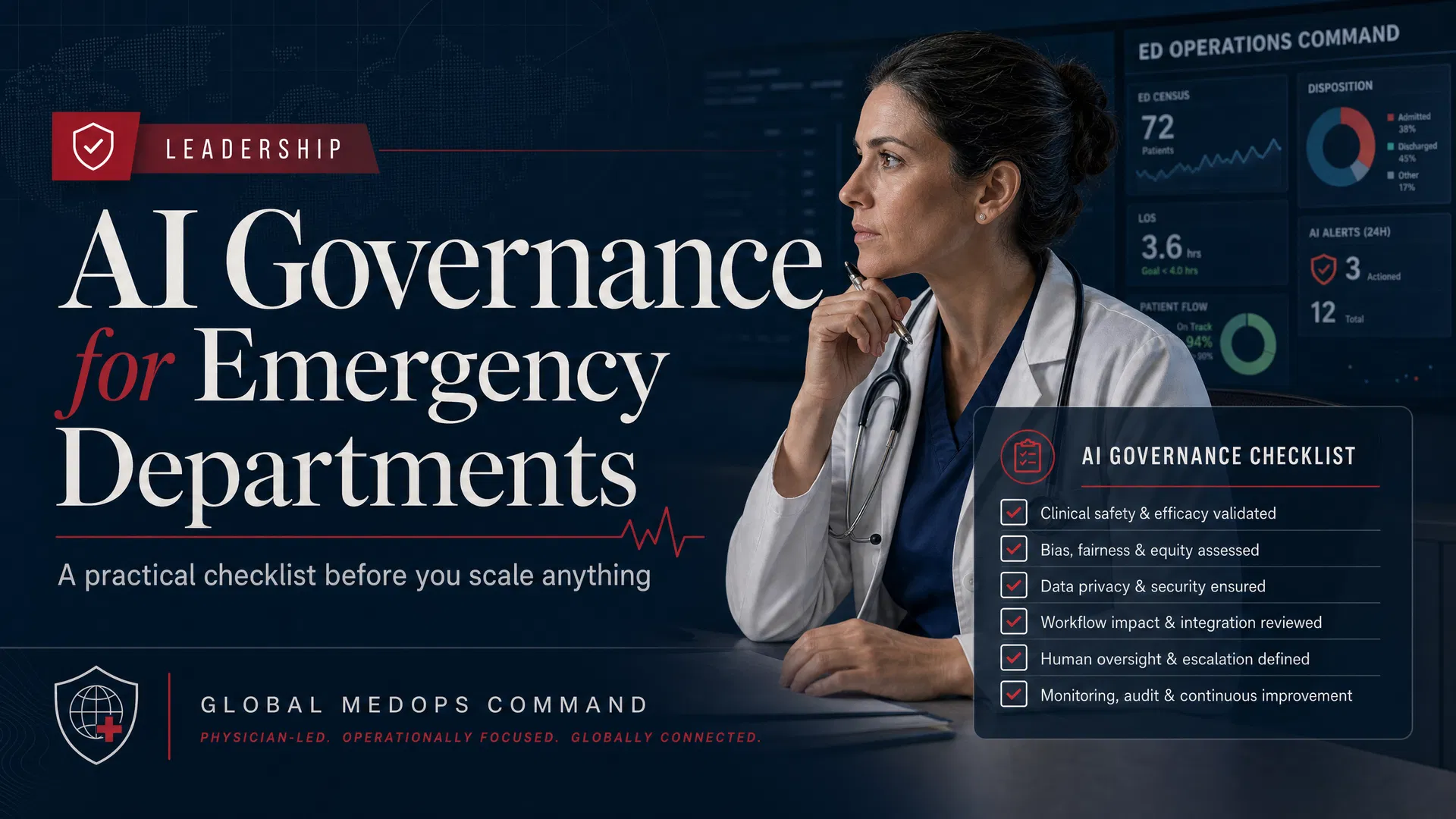
A credible AI governance checklist should cover six questions. What specific clinical or operational problem are we solving? What data and workflow does the tool depend on? Who reviews performance and how often? Which failure modes would make us pause or stop the pilot? How will resident and attending education be handled? What would justify scaling to a wider group or additional site?
Departments should also decide where AI will not be used. High-risk communication, resuscitation settings, and edge-case presentations often deserve a higher threshold. Responsible implementation is not proven by universal deployment. It is proven by knowing where the tool fits and where it does not.
Why scale is a governance decision, not a momentum decision
Scale should follow evidence, not excitement. A tool that works with a few motivated champions may fail when introduced to a wider physician group with different habits, different tolerance for editing, and different patient mix. Governance exists partly to prevent a local convenience from being mistaken for system readiness.
Before scale, leaders should review user variability, chart-level defects, complaint-level performance, and staff trust. They should also ask whether the tool depends on a fragile training model, unusual local support, or a narrow workflow that may not survive broader use. Scale is not a prize for finishing a pilot. It is a new phase with its own risks.
What strong governance looks like to clinicians
Frontline clinicians trust governance when it is visible, practical, and honest. They want to know who is reviewing the tool, how feedback is used, what happens after a miss, and whether leadership is willing to pull back if the system adds risk without enough value. That transparency matters because emergency clinicians do not just want innovation. They want reliability.
A strong governance process also gives physicians language for evaluating vendors, pilots, and internal proposals. It helps departments move from vague enthusiasm to structured questions about accountability, evidence, and operational fit.
The bottom line
Emergency departments do not need an anti-technology stance. They need a disciplined one. Governance is the structure that turns AI adoption from a scattered experiment into a manageable clinical and operational program.
If your group needs a physician-led framework for making those decisions, the AI Bulletproof course, the books and resources hub, and direct speaking or consulting support provide a practical starting point for leaders who want clarity before scale.
Keep reading
Related reading and your next step.
Ready to go further? Move from this article into structured training, scenario-based rehearsal, and more physician-written guidance.
Course
Translate the article into a repeatable framework
Use the physician-led course when you want a structured framework for evaluating AI tools, protecting clinical judgment, and leading implementation decisions.
Simulation
Practice the decision path under pressure
Use EM-Sim when you want scenario-based repetition that turns article-level insight into physician-facing emergency-medicine reps.
Blog
Browse more articles
Explore the full blog for more on AI in emergency medicine, then head to the course and simulation pages when you want the structured next step.
Related Articles
AI in Emergency Medicine
AI Fracture Detection in the ED: What the Evidence Supports
AI fracture tools make clinicians more sensitive in reader studies, and NICE allows four of them under conditions. No randomized trial has yet published patient outcomes. How to deploy one as a second reader.
ED Management
Left Without Being Seen: What Emergency Physicians Can Actually Fix
Patients who leave without being seen come back more often, and the front end that drives most walkouts is the part an emergency physician can redesign. Here is what the evidence supports.
AI in Emergency Medicine
AI for ED Staffing: Forecasts Are Not Shift Plans
AI can forecast emergency department arrivals, but a patient count is not a staffing plan. Learn how to validate forecasts, keep human control, and test a safer workflow.