AI in Emergency Medicine
AI Brain Bleed Alerts on Head CT: What a Negative Flag Means
Why this matters
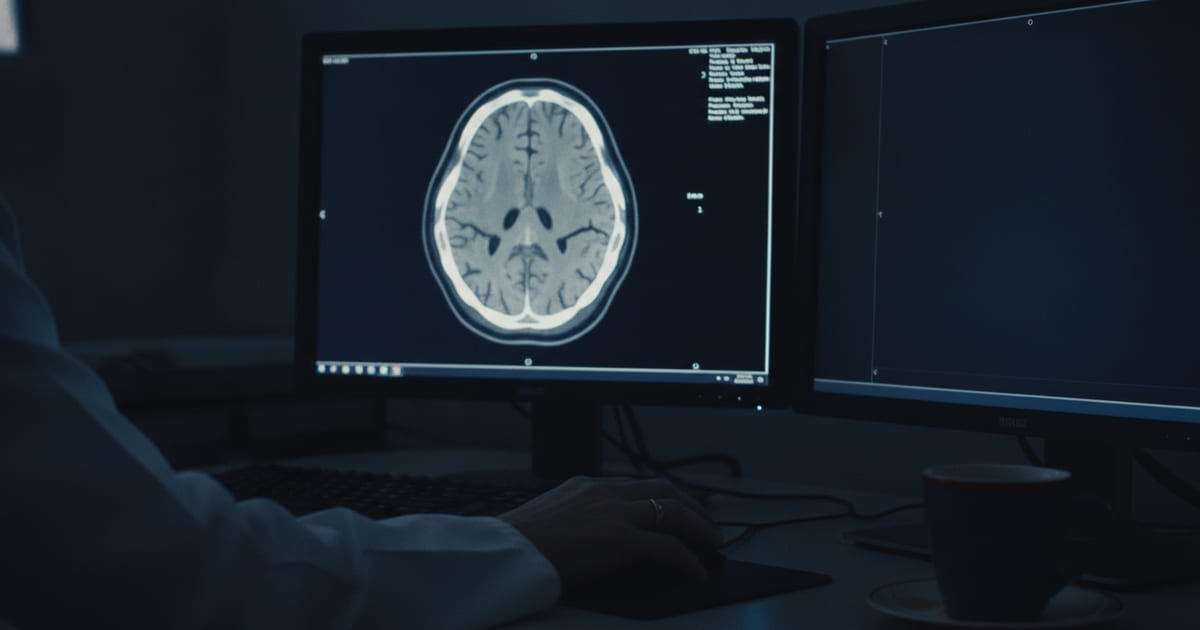
AI intracranial hemorrhage tools move urgent head CTs up the worklist. Real-world data show they miss many subacute, chronic and small bleeds, flag falsely when bleeds are rare, and did not speed reads in a prospective study.
Recommended next step
Pair this article with the free guide or course store if you want a more structured framework you can apply at the bedside or in leadership conversations.
An 81-year-old retired farmer on apixaban tripped over his dog ten days ago and hit the side of his head on the kitchen floor. Tonight his daughter brings him in because he repeats questions. His exam is nonfocal, and his noncontrast head CT finished 20 minutes ago. Your department lets ED physicians see the AI triage result, and the software has processed the scan and raised no flag. The radiology worklist is long, and the final read is still pending. The question on the table is what that missing flag is worth.
Very little, on its own. These tools are built to move urgent scans up a radiologist's list. They are cleared to flag acute hemorrhage, and in real-world use they miss many of the bleeds this patient is most likely to have: subacute, chronic, small and single-compartment collections. A missing flag is not a negative read.
What an ICH triage tool is cleared to do
Commercial intracranial hemorrhage (ICH) triage tools are FDA-cleared as radiological computer-aided triage and notification software under 21 CFR 892.2080 [1]. The indications for one cleared device, typical of the category, describe a workflow tool that helps prioritize review of scans with features suggestive of acute hemorrhage. They state that its results are not intended for stand-alone clinical decision-making and that it is not intended to rule out hemorrhage [1]. Subacute and chronic blood sits outside what that kind of device is built to find. The radiologist's report remains the read.
How the flag reaches the radiologist matters as much as the algorithm. At one academic neuroradiology practice, a pop-up widget and a marked exam on the worklist had no effect on queue-adjusted wait time or turnaround time [2]. When flagged exams were moved up the worklist, queue-adjusted wait time was 12.02 minutes for AI-positive exams against 15.45 minutes for AI-negative ones. The largest gains were for exams ordered as routine, which otherwise sit low in the queue [2].
A missing flag misses the bleeds you worry about
The largest real-world evaluation covered 101,944 noncontrast head CTs at a 17-facility academic health system from 2023 to 2025 [3]. The commercial tool had an overall sensitivity of 82.2% and specificity of 97.6%. Sensitivity was 86.2% for acute hemorrhage, 95.0% for bleeds larger than 10 mm and 93.6% for multi-compartment bleeds. It fell to 45.5% for subacute hemorrhage, 54.8% for chronic hemorrhage, 74.8% for bleeds 10 mm or smaller, 76.0% for single-compartment bleeds and 72.2% in the outpatient setting [3]. Performance was consistent across demographic groups [3]. The reference standard in that study came from radiology reports classified by a large language model, which agreed with manual review in 96% of 500 checked cases [3].
Other data show the same pattern by subtype. In an emergency workflow at a Swiss university hospital, overall sensitivity was 87.2%, but the tool detected 69.2% of subdural hemorrhages and 77.4% of acute subarachnoid hemorrhages [4]. In a 2026 Geneva study of 2,153 emergency head CTs, with the AI output hidden from readers and the attending radiologist's final report as the reference, the AI had a sensitivity of 84% against 96.4% for on-call radiology residents, and a specificity of 94.4% against 99.6% [5]. The AI performed very well only when several hemorrhage types or sites were present [5].
Put the farmer back in the scene. A subdural ten days after a fall is subacute on CT, and in an anticoagulated older adult it is often thin and confined to one compartment. In the largest dataset, that is the profile with the lowest sensitivity [3]. A missing flag changes nothing about observation, a repeat scan or a call to the radiologist.
A positive flag is often wrong when bleeds are rare
Positive predictive value depends on how common bleeding is in the scans being read. In the VA national teleradiology program, 61,704 consecutive head CTs had an ICH prevalence of 2.7% [6]. The tool's sensitivity was 75.6%, its specificity 92.1% and its positive predictive value 21.1%: about four of every five flags were false. Falsely flagged scans took longer to read than unflagged normal scans, an average of 9 minutes 40 seconds against 8 minutes 38 seconds [6]. The authors concluded that in a high-volume, low-prevalence setting, the inefficiency may outweigh the benefit [6].
The Swiss deployment listed the usual false-positive causes: postoperative and post-ischemic defects (23.6%), artifacts (19.7%) and tumors (15.3%) [4].
Children are a separate question. ICH detection tools are generally cleared for adults only [9]. In a 21-site retrospective study of 1,996 head CTs in patients aged 6 to 17, an adult-trained tool had a sensitivity of 94.2% and a specificity of 94.7%, but a positive predictive value of 62.5% at a prevalence of 8.6% [9]. Streak artifact (21.6%) and misclassified anatomy (18.6%) were the two most common causes of false positives. The authors judged performance comparable to adult performance and said adapted tools could widen access, but called for prospective validation before clinical use in children [9]. One author works for the vendor. A department that runs an adult tool on every head CT should know whether its pediatric scans pass through it.
Speed and accuracy in prospective use
The strongest workflow test is a prospective single-center study of 9,954 head CTs from 7,371 adults, read by neuroradiologists and emergency radiologists without AI in one phase and with it in the next [7]. Accuracy (99.5% against 99.2%), sensitivity (98.6% against 98.9%) and negative predictive value (99.7% in both) did not change. Specificity was slightly higher without AI (99.8% against 99.3%). Mean report turnaround for ICH-positive scans was 147.1 minutes without AI and 149.9 minutes with it [7]. The authors concluded that the study does not support AI assistance for ICH detection [7]. Those radiologists already performed near the ceiling, about one in five scans was positive, and the notice was a pop-up rather than a reordered worklist. A department with a different reader mix or setup could see a different result.
The effect on emergency clinicians depends on experience. In a simulated study at a Korean tertiary ED, 10 emergency medicine professionals read CTs with clinical information, first without and then with an algorithm [8]. Experienced readers barely changed. Less experienced readers gained sensitivity (59.33% to 72.67%) and lost specificity (65.49% to 53.73%), and they changed decisions more often, mainly because of the algorithm's false positives [8].
The same caution about a tool's silence runs through our reviews of AI stroke alerts and AI ECG reads.
Key Takeaways
- In 101,944 real-world head CTs, sensitivity was 82.2% overall but 45.5% for subacute, 54.8% for chronic and 74.8% for small bleeds.
- At a 2.7% prevalence, positive predictive value was 21.1%, and false flags added reading time.
- In a prospective study of 9,954 scans, AI triage did not improve radiologist accuracy or turnaround for ICH-positive scans, 147.1 against 149.9 minutes.
- In one academic practice, only reordering the radiologist's worklist shortened wait times; a pop-up alone did not.
FAQ
How accurate is AI at detecting brain bleeds on CT?
In the largest real-world study, 101,944 scans, one commercial tool had 82.2% sensitivity and 97.6% specificity [3]. Sensitivity was high for large, acute and multi-compartment bleeds and much lower for subacute (45.5%), chronic (54.8%) and small (74.8%) bleeds.
Can a negative AI result rule out intracranial hemorrhage?
No. The cleared indications for one such device, typical of the category, say it is not intended to rule out hemorrhage or to be used alone for clinical decisions [1]. The radiologist's read and the clinical picture decide disposition.
Does AI speed up head CT reads for brain bleeds?
Sometimes. Reordering the radiologist worklist shortened wait times for flagged scans in one practice [2]. In a prospective study of 9,954 scans, report turnaround for ICH-positive scans did not improve [7].
Dr. Chet's Take
I have worked as an emergency physician for more than 25 years at a Level I academic trauma center, and this article reaches the right conclusion about the one result that worries me most: the scan with no flag. A flag is a request for attention. Silence is not a clearance. The tools in these studies do what they were cleared to do. They push big, obvious, acute bleeds up the list, and they do it reasonably well. The trouble starts when the person at the bedside reads a missing flag as a normal scan, and nothing in the software stops that. The argument holds, and the subtype data make it concrete.
That being said, the article's opening patient is the one most exposed, and he is not rare. The low-sensitivity profile in these data, subacute, chronic, small and single-compartment, describes the older adult who fell days ago and comes in confused, often on a blood thinner. Emergency departments see that patient every day, and he is easy to send home on a quiet overnight. The honest answer is that I do not know how many ED physicians can see the AI output at all, or how they read a blank where a flag would be. My guess is that few departments have asked. If clinicians can see the tool, the department owes them a written rule for what its silence means.
If you are leading an emergency department, find out this week whether your physicians can see the triage flags, and if they can, publish one sentence: no flag is not a negative read. Ask radiology for the local flag rate and the confirmed-bleed rate every quarter, broken out by bleed age, because a single sensitivity figure hides the subdural problem. If you are the attending, wait for the read on the anticoagulated faller, or call for it. A missing flag is a reason to look harder, never a reason to stop looking.
— Chester Shermer, MD, FACEP | Emergency Medicine, 25+ Years Clinical Experience | State Surgeon
Continue Your Training
If you're an emergency physician (or any clinician treating patients daily) trying to understand how AI will actually impact your clinical practice — not just the hype — I put together a free practical guide. You can download the AI in EM Survival Guide here.
Browse All Courses at Global MedOps Command
Relevant Reading on Global MedOps Command:
How to Avoid Becoming an AI Casualty — Dr. Shermer's guide to navigating AI tools in clinical and operational settings without compromising judgment or patient outcomes.
Emergency Department Efficiency Playbook — Practical systems for throughput, triage optimization, and operational efficiency.
Read more from Dr. Shermer on Medium
Connect with Dr. Shermer: LinkedIn — Chester "Chet" Shermer, MD, FACEP.
References
- US Food and Drug Administration. 510(k) K182177, AccipioIx, radiological computer aided triage and notification software, 21 CFR 892.2080: indications for use. accessdata.fda.gov
- O'Neill TJ, Xi Y, Stehel E, et al. Active Reprioritization of the Reading Worklist Using Artificial Intelligence Has a Beneficial Effect on the Turnaround Time for Interpretation of Head CT with Intracranial Hemorrhage. Radiol Artif Intell. 2020;3(2):e200024. PubMed 33937858
- Chavoshi M, Mansuri A, Bala W, et al. Real-world performance evaluation of a commercial deep learning model for intracranial hemorrhage detection. NPJ Digit Med. 2026;9(1):66. PubMed 41444826
- Seyam M, Weikert T, Sauter A, et al. Utilization of Artificial Intelligence-based Intracranial Hemorrhage Detection on Emergent Noncontrast CT Images in Clinical Workflow. Radiol Artif Intell. 2022;4(2):e210168. PubMed 35391777
- Pedrini Q, Chrysostomou PC, Poletti PA, et al. Performance of AI vs radiology residents in the detection of intracranial hemorrhage on emergency CT: a real-world analysis. Eur Radiol. 2026;36(7):5996-6006. PubMed 41721849
- Del Gaizo AJ, Osborne TF, Shahoumian T, et al. Deep Learning to Detect Intracranial Hemorrhage in a National Teleradiology Program and the Impact on Interpretation Time. Radiol Artif Intell. 2024;6(5):e240067. PubMed 39017032
- Savage CH, Tanwar M, Elkassem AA, et al. Prospective Evaluation of Artificial Intelligence Triage of Intracranial Hemorrhage on Noncontrast Head CT Examinations. AJR Am J Roentgenol. 2024;223(5):e2431639. PubMed 39230402
- Choi SY, Kim JH, Chung HS, et al. Impact of a deep learning-based brain CT interpretation algorithm on clinical decision-making for intracranial hemorrhage in the emergency department. Sci Rep. 2024;14(1):22292. PubMed 39333329
- Cavallo J, Sher A, Chen D, et al. Performance of an adult-trained AI tool for intracranial hemorrhage detection on head CT in children aged 6-17 years. Pediatr Radiol. 2026;56(3):649-657. PubMed 41619014
Related simulation training: EM-Sim · Books by Dr. Shermer
Keep reading
Related reading and your next step.
Ready to go further? Move from this article into structured training, scenario-based rehearsal, and more physician-written guidance.
Course
Translate the article into a repeatable framework
Use the physician-led course when you want a structured framework for evaluating AI tools, protecting clinical judgment, and leading implementation decisions.
Simulation
Practice the decision path under pressure
Use EM-Sim when you want scenario-based repetition that turns article-level insight into physician-facing emergency-medicine reps.
Blog
Browse more articles
Explore the full blog for more on AI in emergency medicine, then head to the course and simulation pages when you want the structured next step.
Related Articles
AI in Emergency Medicine
AI Stroke Alerts in the ED: Faster Transfers, Silent Misses
Automated LVO detection cut door-to-groin time by 11 minutes in a randomized trial, but it misses a meaningful share of occlusions. Here is how emergency physicians should use the alert.
AI in Emergency Medicine
AI Fracture Detection in the ED: What the Evidence Supports
AI fracture tools make clinicians more sensitive in reader studies, and NICE allows four of them under conditions. No randomized trial has yet published patient outcomes. How to deploy one as a second reader.
AI in Emergency Medicine
AI ECG Potassium Alerts: What the ED Trial Showed
The only randomized trial of an AI-ECG potassium alert in emergency physicians sped hyperkalemia treatment in flagged patients. Outcomes, accuracy, and the pathway you need first.